Sourcing & Procurement
Adding a Japan Section to Your Wholesale Offering: A Playbook for US Distributors
A 90-day playbook for US distributors who want to add a Japan section to their wholesale offering — how to validate demand with existing accounts, pick a starting category, choose a supply route, build a landed-cost model, equip your sales team, and establish a reorder loop.

On this page
Key takeaways
- A Japan section is a category extension your competitors probably can't copy quickly — most US distributors don't carry one, so it differentiates your shelf rather than duplicating it.
- Validate demand against your existing accounts before you source a single SKU. Your buyers already tell you what their shelves are missing.
- Start with one category, not a whole 'Japan' aisle. A narrow, deep first selection is easier to sell, easier to reorder, and easier to learn from.
- Your landed-cost model is the spine of the program. Import duties and international freight are real on every Japanese import — plan them in from day one.
- The maker's story is a sales asset. Products refined for decades for the Japanese market come with a reason-to-buy your sales team can carry into accounts.
The situation: your accounts want a differentiated shelf
If you distribute to a hundred-plus retail accounts, you know the pressure your buyers are under. Their shelves look like everyone else's. The lines you carry, your competitors carry too — so the conversation with your accounts keeps coming back to price, because there's nothing else to compete on when the assortment is identical.
A Japan section changes that conversation. Curated Japanese product — stationery, skincare, snacks, kitchenware, design goods — is a category most US distributors simply don't offer. That's the point of the play: you're not adding more of what your accounts can already get from three other distributors. You're adding a category that gives their shelf a reason to look different, which gives your line a reason to be on it.
This is a practical playbook for adding that section without overextending. It assumes you run a real distribution business — a catalog, a sales team, standing accounts — and works inside that reality rather than asking you to become an importer overnight. The structure is a 90-day sequence, because that's roughly how long it takes to go from "we should look at Japan" to "we have a reorder loop running on a tested category."
① Why Japan, specifically
Before the how, the why — because a Japan section only earns shelf space if there's pull behind it.
The clearest signal is what's already crossing the border. Japan's agricultural and food exports rose 12.8% year on year to a record ¥1.70 trillion in 2025, and the United States was the top destination at ¥276.2 billion, up 13.7% — green tea and matcha among the strongest growers. (Nippon.com / MAFF data) That's not a niche curiosity; that's a category with momentum into US channels.
Specific verticals tell the same story:
- Snacks are moving from specialty into mainstream retail. Products like Pocky have been appearing on shelves at mainstream US retailers, and Japanese manufacturers have stood up US-based innovation and subscription operations specifically to serve American demand — a sign they see the channel as durable, not a fad. (Food Business News — snack trends)
- Skincare (J-beauty) has a substantial, growing US base. North America's J-beauty demand is concentrated in the US, and skincare specifically is the largest slice of that demand — driven by the minimalist, maintenance-first routines younger shoppers favor. (Future Market Insights — J-beauty)
- Stationery has a global reputation for quality and function. Japan's writing-instrument export value reached roughly ¥120 billion in 2023, up nearly 15% from 2018, and brands like Pilot, Pentel, and Sakura are household names well beyond Japan. (Japan Writing Instruments Manufacturers Association, via FedEx Business Insights)
Read these figures for what they are: direction and durability of demand, not a guaranteed sell-through rate for your accounts. The honest takeaway is that Japanese product in these categories has real, sustained pull in the US — enough to justify a tested, disciplined entry, which is what the rest of this playbook is for.
It helps to understand why this product is distinctive. Many of the strongest Japanese makers have spent decades refining their products for a demanding domestic market, selling through long-standing domestic relationships. Their catalogs are world-class — the reason they're hard to reach from overseas isn't quality, it's that the routes to find them were built for Japan, not for a US distributor. That's also why a curated Japan section is hard for competitors to copy: the supply isn't sitting in an easy-to-onboard channel.
② The 90-day playbook
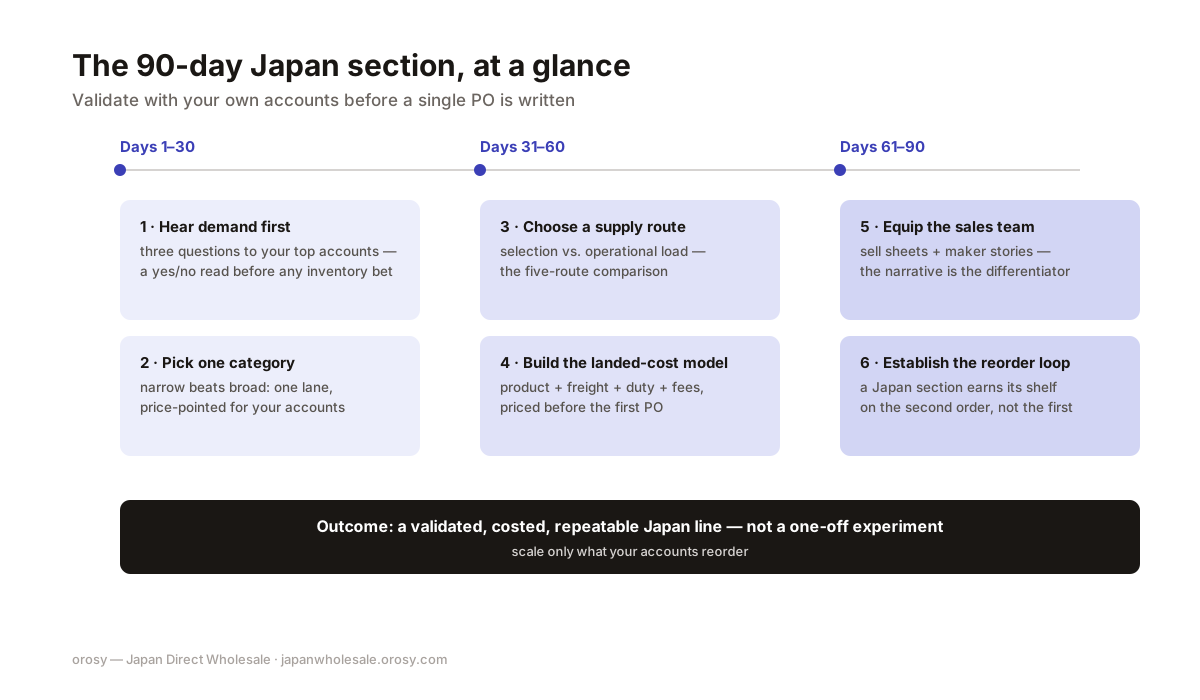
Step 1 — Hear demand from your existing accounts first
Don't start by browsing Japanese suppliers. Start by asking the accounts you already serve. You have a built-in research panel that most new-category bets never get: a hundred buyers who tell you, on every call, what their shelves are missing.
Run a short, structured pass with your sales team over two weeks. For your top accounts, ask three questions: Are your customers asking for Japanese product? In which category? At what price point and pack size? The goal isn't a forecast — it's a yes/no signal on whether demand is real in your accounts specifically, plus a first read on which category leads. If the demand isn't there, you've spent two weeks instead of a season's worth of inventory finding out.
Step 2 — Pick one starting category, and go narrow
The instinct is to launch a "Japan section" — a broad aisle spanning snacks, beauty, stationery, and homeware at once. Resist it. A wide first launch spreads your attention, your cash, and your sales team's learning across too many SKUs to manage well.
Pick the single category your account survey pointed to, and go deep in it rather than wide across all of Japan. A tight, well-chosen first selection is easier to pitch ("we've added Japanese skincare," not "we've added Japan"), easier to merchandise on your accounts' shelves, easier to reorder, and easier to read for what's working. You can broaden later — and you'll broaden informed, on the back of real sell-through data, instead of guessing across five categories on day one.
Step 3 — Choose your supply route
Once you know the category, decide how you'll source it. There are five established routes — US-based Japanese-goods importers, Japanese trade shows, direct manufacturer contracts, B2B marketplaces, and buying agents or trading companies — and each trades selection against operational load. The easiest routes give you a narrow, pre-cleared catalog; the broadest selection asks you to handle language, minimums, customs, and freight yourself.
This is a decision worth making deliberately rather than defaulting into, because the route you pick caps both your selection and your margin. We compared all five in detail — including who carries the customs and freight work in each — in our guide to sourcing Japanese products wholesale in the US. Read that, match a route to your category and volume, and then come back to the cost model.
Step 4 — Build a landed-cost model before you commit inventory
This is the step that separates a program that holds its margin from one that quietly erodes it. Before you place a first order, model the full landed cost of a representative SKU — not just the unit price.
Two facts make this tractable. Under the 2025 US–Japan framework, most Japanese consumer goods are tariffed at roughly 15%, and that figure is inclusive of the pre-existing most-favored-nation (MFN) rate rather than stacked on top of it — so it's not a double charge. The exact rate comes down to each product's HTS classification, so it varies by category rather than applying as one flat number; a few categories (some porcelain tableware, for instance) sit higher. And duties are ad valorem — the same percentage whether you import a sample order or a container — so once you know a SKU's rate, it scales cleanly. (Congressional Research Service, White House Federal Register notice)
Whether you owe these costs directly depends on your route from Step 3 — buy from a domestic importer and they're already inside your price; source direct and you carry them yourself. Either way, build them into the model. Our walkthrough of importing Japanese products: customs, duties, and logistics covers how to construct that landed-cost view line by line. The output you want is a per-SKU landed cost you can set wholesale pricing on with confidence — so the margin you quote your accounts is the margin you actually keep.
Step 5 — Equip your sales team
Your section won't sell itself through a hundred accounts; your reps will. Give them two things.
First, a sell sheet per SKU or small bundle: a clear product shot, the pack size and case quantity, your wholesale price, the suggested retail, and the resulting margin for the account. Buyers decide fast on a clean sheet that does the math for them.
Second — the part most distributors skip — the maker's story. A Japanese product carrying decades of craft refinement comes with a reason-to-buy a generic line doesn't have: who makes it, how long they've made it, what they're known for in Japan. That narrative is a genuine sales asset, because it gives the retail buyer something to tell their customer. Brief your reps on the story behind each SKU the way you'd brief them on the spec sheet. A rep who can say "this maker has refined this for thirty years for the Japanese market" closes differently than one who can only quote a price.
Step 6 — Establish the reorder loop
A category extension isn't a success when the first order lands — it's a success when it reorders. The last step builds the loop that turns a one-time buy into a standing line.
Track sell-through at the account level on your starting SKUs and watch which ones move. Set reorder triggers on the winners before they stock out, prune the SKUs that don't pull, and feed what you learn back into Step 2 — that's when you widen the section, into the next category your data (not your hunch) tells you to add. The discipline is the same that runs the rest of your catalog; the only new variable is the longer replenishment lead time on Japanese supply, which makes reorder timing something to manage proactively.
③ Three common ways this goes wrong
The playbook above is the disciplined path. Here are the three failure modes that pull distributors off it.
Do this
- Launch one category deep, validated against your accounts, with a landed-cost model behind every SKU and a reorder loop on the winners.
- Frame your section on product quality and the maker's story — durable reasons your accounts can carry to their own customers.
- Quote replenishment timing on Japanese supply conservatively, with margin for international lead times.
Avoid this
- Going too wide, too fast. A whole 'Japan' aisle on day one spreads cash and attention across too many SKUs to manage — and you can't tell what's working. Start narrow; broaden on data.
- Over-promising delivery dates to accounts. Japanese replenishment carries international lead times, and a buyer who's been promised a date you miss won't reorder. Quote timing you can hold.
- Leaning on 'Japan-ness' as decoration instead of choosing on product strength. A section built on cherry-blossom-and-Fuji styling rather than genuinely strong products is a costume. Pick SKUs your accounts' customers actually want; let the product — not the aesthetic — carry the section.
That third point is worth dwelling on, because it's the easiest trap to fall into. The pull behind a Japan section is real product that's genuinely good — stationery that writes better, skincare that performs, snacks people seek out. It is not the visual shorthand of "Japan." A section curated for product quality, with the maker's story as the proof, sells and reorders. A section curated to look Japanese sells once.
orosy — Japan Direct Wholesale
If you'd rather not assemble the import operation yourself, this is the gap orosy is built to fill. The name comes from the Japanese word orosu (卸す), meaning "to wholesale." Founded in 2018, orosy connects US buyers to a wide breadth of Japanese supply — 4,000+ Japanese brands and suppliers, over 1 million products, and 20,000+ buyers on the marketplace — so your Japan section isn't bounded by one importer's shortlist; you can reach across nearly the full range of what Japan makes and pick what your accounts actually want, while orosy handles the sourcing, customs, and international logistics on your behalf. The costs that don't disappear — duties and freight — pass through and are billed at cost, so your landed-cost model stays honest. And because orosy buys at Japanese wholesale prices through direct, long-standing supplier relationships, your pricing is built on that purchasing power, with fewer intermediaries between you and the maker than a typical import chain.
If a curated Japan section fits where your distribution business is headed, you can join the waitlist:
FAQ
How long does it take to add a Japan section to a distribution catalog?
A disciplined first launch fits in roughly 90 days: about two weeks validating demand with your accounts, a few weeks selecting a category and supply route and building the landed-cost model, then ordering, equipping your sales team, and watching for the first reorders. Going faster usually means skipping the validation or cost-modeling steps — which is where most failed launches go wrong.
Should I launch with one category or a full Japan aisle?
One category, deep. A broad "Japan" aisle on day one spreads your cash, your sales team's attention, and your read on what's working across too many SKUs to manage. Pick the single category your account survey pointed to, prove it reorders, then broaden onto real sell-through data rather than a hunch.
How do import duties affect the margin on a Japan section?
Plan them in from the start. Under the 2025 US–Japan framework, most Japanese consumer goods land at roughly 15%, inclusive of (not added to) the MFN rate, with the exact figure set by each product's HTS classification — so it varies by category. Duties are ad valorem, so the rate is the same regardless of order size. If you buy from a domestic importer the duty is already inside your price; if you source direct, you carry it — either way it belongs in your landed-cost model before you set wholesale pricing.
What makes a Japan section harder for competitors to copy than a normal category extension?
The supply isn't sitting in an easy-to-onboard channel. Many of the strongest Japanese makers sell through long-standing domestic relationships and aren't set up to export, so reaching a deep, curated selection takes real sourcing work. Most US distributors don't do that work — which is exactly why a well-built Japan section differentiates your shelf instead of duplicating what every other distributor already carries.
How does orosy fit into this playbook?
orosy covers the supply-route and operational steps. It connects buyers to a wide breadth of Japanese supply — 4,000+ brands and over 1 million products — and handles sourcing, customs, and international logistics, while duties and freight pass through billed at cost. You keep the parts that are yours: validating demand with your accounts, choosing the category, pricing, and equipping your sales team. orosy handles Japan.
Sources
- Japan's Food Exports Rise to ¥1.7 Trillion in 2025, Nippon.com (MAFF data): https://www.nippon.com/en/japan-data/h02696/
- Snack trends 2026, Food Business News: https://www.foodbusinessnews.net/articles/29509-snack-trends-2026
- J-Beauty Product Market Size & Industry Trends, Future Market Insights: https://www.futuremarketinsights.com/reports/j-beauty-product-market
- Why the World Loves Japanese Stationery (Japan Writing Instruments Manufacturers Association data), FedEx Business Insights: https://www.fedex.com/en-cn/business-insights/ecommerce/how-japanese-stationery-is-winning-over-the-world.html
- US Tariffs and the 2025 US–Japan Framework Agreement, Congressional Research Service: https://www.congress.gov/crs-product/IN12608
- Implementing Certain Tariff-Related Elements of the United States–Japan Agreement, Federal Register: https://www.federalregister.gov/documents/2025/09/16/2025-17908/implementing-certain-tariff-related-elements-of-the-united-states-japan-agreement
orosy — Japan Direct Wholesale
Choose from Japan’s full shelf — not someone else’s catalog.
orosy connects US buyers to 5,000+ Japanese brands and 200,000+ products, and handles sourcing, customs, and international logistics — while duties and freight pass through, billed at cost.
Join the waitlistWritten by
Kanji NoguchiFounder, orosy
Founder of orosy. Building direct wholesale access between Japanese brands and US buyers.
Keep reading
Sourcing & Procurement
Adding a Japanese Line to Your Card: A Playbook for Sales Reps & Agencies
June 8, 2026 · 7 min read
Sourcing & Procurement
Adding Japanese Supply to Your B2B Marketplace: A Playbook for Platform Operators
June 8, 2026 · 8 min read
Sourcing & Procurement
Broadening Your Japanese Line: A Playbook for Regional Importers
June 8, 2026 · 8 min read