Marketplaces
Faire for Japanese Brands vs. Sourcing Direct from Japan: What US Retailers Should Know
Faire is the marketplace leader US buyers love — and for good reason. This honest guide explains when Faire's Japanese selection is exactly what you need, and when its structure means the Japanese brands you want simply aren't on it, with a neutral comparison of Faire, direct sourcing, and a handled sourcing model.

On this page
- Start here: Faire is very good, and this isn't a takedown
- What buying Japanese products on Faire gets right
- The part you don't see: what it takes for a Japanese brand to sell on Faire
- What this means for you as a buyer
- Faire vs. direct sourcing vs. a handled model: an honest comparison
- When Faire is the right call (and we mean that)
- Where orosy fits
- FAQ
Key takeaways
- Faire is a genuinely excellent place to buy: net terms, a smooth ordering flow, and a Trustpilot score of 4.4/5 across ~1,000 reviews. This guide isn't a knock on Faire.
- Faire does accept Japan-based brands — there's an official guide for it. The constraint isn't a ban; it's that a Japanese brand has to self-manage four things to be listed.
- Those four self-service burdens (a US-dollar account, self-arranged international shipping, exporter customs responsibility, and marketplace fees) mean the Japanese roster skews toward the export-ready few.
- A recurring honest gripe among US retailers on marketplaces is that every store ends up able to order the same merchandise — worth weighing if differentiation matters to you.
- Faire is the right answer for plenty of buyers. The question this guide answers is when it's enough, and when the brand you want is on the part of Japan's supply that never makes it onto a marketplace.
Start here: Faire is very good, and this isn't a takedown
If you're a US retail buyer, you have probably already used Faire, or you're considering it. There's a reason it became the default. The ordering experience is clean and modern, net payment terms ease your cash flow, and the discovery feels more like shopping than like cold-emailing suppliers. The reputation backs it up: Faire holds a Trustpilot rating of around 4.4 out of 5 across roughly 1,000 reviews, which is a strong score for any B2B platform. (Trustpilot rating summary, via Honest Brand Reviews)
So this article is not a "Faire is bad" piece. It's the opposite: Faire is a marketplace leader, and for a lot of Japanese-product buying it's a perfectly good answer. The useful question for a professional buyer isn't Faire or not Faire. It's narrower and more honest: when is Faire's Japanese selection exactly what you need, and when is the brand you actually want sitting on a part of Japan's supply base that a marketplace structurally can't reach?
To answer that well, you have to look at two things separately: what Faire is like to buy from (genuinely good), and what it takes for a Japanese brand to sell on it (the part that quietly shapes what you can choose from).
If you want the broader map of sourcing routes first, our guide on how to source Japanese products wholesale in the US walks through all five. This piece zooms in on the Faire-versus-direct decision specifically.
What buying Japanese products on Faire gets right
Let's give Faire its full due before we get to structure, because these strengths are real and they matter to your day-to-day.
Why buyers like it
- Net terms: Faire is known for net payment terms that let you receive product and pay later, which is a meaningful cash-flow advantage for a small or mid-size retailer.
- A familiar, modern ordering flow: discovery, cart, and reorder all work the way you'd expect from consumer ecommerce, with no language barrier and no manual export paperwork on your side.
- Curated discovery: there's a dedicated Japanese-products section, so you can browse a pre-filtered set of brands rather than hunting suppliers one by one.
- Strong overall reputation: a 4.4/5 Trustpilot score across ~1,000 reviews tells you the large majority of buyers have a good experience.
Honest caveats (from retailers, not us)
- A recurring retailer gripe on marketplaces generally is sameness: one independent store owner put it as 'every store in our area can order exactly the same merchandise.' If a differentiated assortment is your edge, that's worth weighing.
- Some retailers question whether listed prices always beat a brand's own direct wholesale — a few reviews note items priced '10–20% higher' on the marketplace than on a brand's own site. It varies by brand; it's a thing to spot-check, not a rule.
The "same merchandise" observation comes from an independent retailer's first-hand column, and the pricing note from a platform review aggregating buyer feedback; both are buyer-side perspectives worth knowing, not disqualifiers. (retailer perspective, Gifts & Decorative Accessories, platform review, WizCommerce)
None of that takes away from the core point: as a place to buy, Faire works. The thing that's easy to miss is upstream of you — in what it takes for a Japanese brand to get listed in the first place.
The part you don't see: what it takes for a Japanese brand to sell on Faire
Here is the fact that's frequently gotten wrong, so let's state it plainly first: Faire does accept Japan-based brands. There is an official Faire guide for selling internationally from Japan — it even recommends specific carriers like Yamato and Japan Post for shipping orders out of Japan. A US entity is not required to list. (Faire — international selling guide, Faire — available countries)
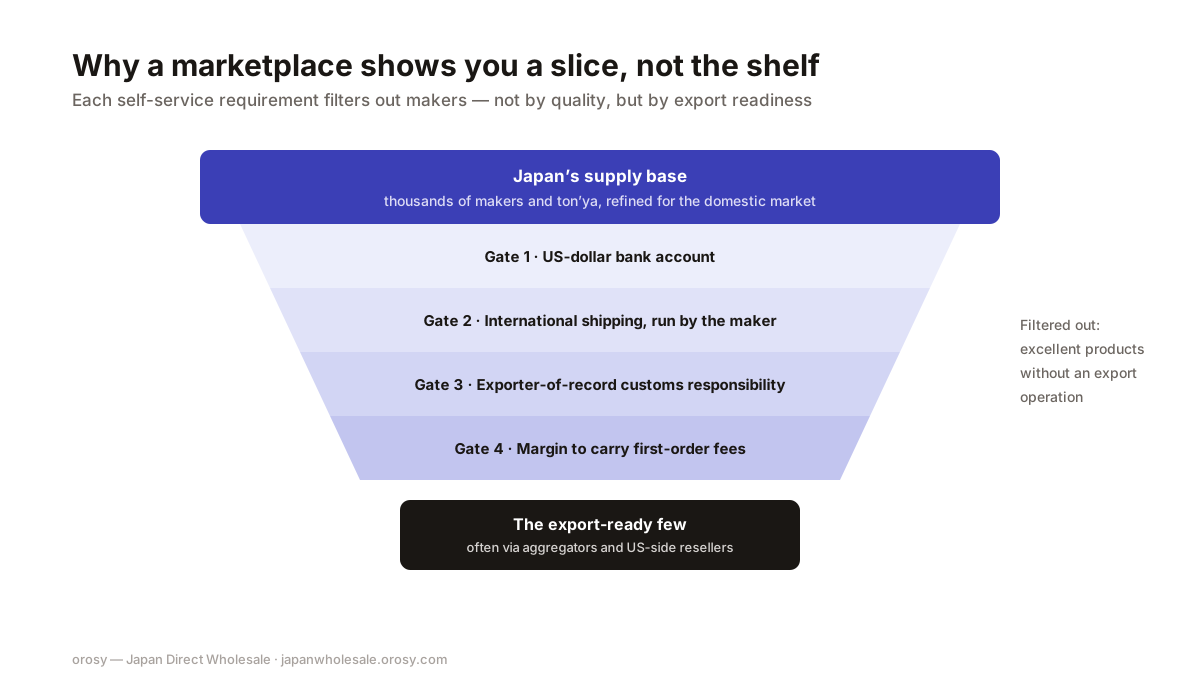
What is required is that the Japanese brand carries four cross-border burdens on its own. This is self-service, and it's the quiet mechanism that shapes the Japanese selection you eventually browse:
- A US-dollar bank account. Brands outside Faire's core countries are paid in USD into a US-based account. Faire's own help center notes you'd obtain a US routing and account number through a provider (it points to OFX as an example) — doable from Japan, but it's a step the maker has to set up and maintain. (Faire — costs & account requirements for non–North American brands)
- Self-arranged international shipping. Per Faire's guide, brands located in Japan have access to "Ship on Your Own" only — the maker books and pays for the international shipment itself, using a carrier like Yamato, Japan Post, or an integrator. There's no marketplace-managed fulfillment doing it for them. (Faire — international selling guide)
- Exporter-of-record customs responsibility. Faire is explicit that any brand selling on the platform is the exporter of record, responsible for complying with the rules of every country it sells into and for assigning correct tariff codes. The retailer is the importer who pays duties — but the brand owns the export-side compliance. (Faire — duties & exporter responsibility)
- Marketplace fees. For brands outside Faire's core regions, a marketplace order carries the standard 15% commission plus a one-time 10% new-customer fee — so 25% on a first order, then 15% on reorders. Reasonable economics for an export-ready company; a real hurdle for a small domestic-focused maker. (Faire — costs for non–North American brands)
Put those four together and you can see the selection effect without anyone being shut out. A maker that has a USD account, an international shipping setup, customs know-how, and the margin to carry a 25% first-order fee can list and thrive. A maker that has spent decades perfecting product for the Japanese domestic market — and sells through long-standing domestic relationships — usually has none of those four things ready, not because the product isn't excellent, but because exporting was never their channel.
That's why much of the Japanese supply on a marketplace arrives through aggregators — for example, Japan-based wholesalers that bundle many makers behind one export-ready account — or through US-side resellers who buy in Japan and re-list. (One Japan-based aggregator, Japacolle, has listed on Faire since 2020 and represents 190+ Japanese makers behind a single account; it's a clear example that Japan-based supply can reach Faire, just usually via a consolidator rather than each maker alone.) (Japacolle brand page on Faire)
What this means for you as a buyer
Translate the supplier-side mechanics into buyer-side consequences, and two things follow.
The Japanese roster skews to the export-ready few. The brands you can browse are, by construction, the ones that cleared those four hurdles or paid a consolidator to clear them on their behalf. That's a genuinely useful, real slice of Japanese product — but it's a slice. The maker you saw on a trip, or the niche brand a customer keeps asking for, may simply never appear, because it was never set up to export and no aggregator happened to carry it.
Assortments tend to converge. Because everyone is choosing from the same onboarded roster, the "every store can order the same merchandise" critique that retailers raise about marketplaces applies to the Japanese section too. (retailer perspective, Gifts & Decorative Accessories) If your edge is carrying things the shop down the street can't, a curated marketplace roster is working against that by design — it's curated for discoverability, which is the same thing as filtered.
To be clear, neither consequence is a failure on Faire's part. A marketplace's job is to make a clean, reliable, browsable set — and filtering is how it stays clean and reliable. The point is just that what you can choose from is decided upstream of you, by who could clear the export hurdles, before you make a single buying decision.
Faire vs. direct sourcing vs. a handled model: an honest comparison
There are three broad ways to get Japanese product into your assortment. None is universally "best" — they trade selection, effort, and predictability against each other.
| Buy on Faire | Source direct from Japan | Handled sourcing model | |
|---|---|---|---|
| What you choose from | Onboarded Japanese roster (export-ready brands + aggregators) | Potentially Japan's full supply base — if you can reach and qualify it | A broad breadth of Japanese supply, reached on your behalf |
| Operational load on you | Low — familiar ordering, no export paperwork on your side | Highest — language, MOQs, export docs, customs, freight are all yours | Low — sourcing, customs, and logistics are handled for you |
| Ordering experience | Modern marketplace flow with net terms | Direct supplier comms, often in Japanese, per-supplier terms | A single workflow instead of assembling importers and forwarders |
| Customs & freight | Duties are yours as importer; brand handles export side | Entirely yours — you are the importer of record | Duties and freight pass through, billed at cost |
| Differentiation | Shared roster — assortments can converge | High — you can carry what no one else found | Broader-than-roster access, so less convergence pressure |
| Best fit | Buyers who want curated discovery and net terms now | High-volume buyers with in-house import capacity and time | Buyers who want wide selection without running the import stack |
The pattern is the familiar one in Japanese sourcing: the easiest route to operate gives you a pre-filtered roster, and the route with the widest selection asks you to run the whole import operation yourself. A handled model exists to try to break that trade-off — broad access without you assembling the logistics — which is the lane orosy sits in, described below.
When Faire is the right call (and we mean that)
It would be dishonest to imply Faire is the wrong choice. For a lot of buyers it's the right one. Reach for Faire when:
- You want curated Japanese product without operational change. If you're testing the category and want a clean, browsable set with net terms, the marketplace flow is hard to beat.
- The export-ready roster already covers what you need. Plenty of strong Japanese brands are on Faire (directly or via aggregators). If your wish list is on it, there's no reason to do more work.
- Cash-flow timing matters to you. Net terms are a real, concrete benefit, and not every alternative offers them.
- You value one consolidated account across many categories, Japanese and otherwise, in a single familiar checkout.
Reach for direct sourcing or a handled model instead when the brand you specifically want isn't on the roster, when your edge depends on carrying things competitors can't, or when you want access to Japan's breadth without inheriting someone else's curation.
Where orosy fits
orosy was built for the buyer in that second situation — the one who wants the part of Japan's supply that doesn't make it onto a marketplace roster, without having to personally run the import operation to get it.
The name comes from the Japanese word orosu (卸す), "to wholesale." Rather than choosing from the brands that happened to clear the export hurdles, orosy connects US buyers to a wide breadth of Japanese supply — 4,000+ Japanese brands and suppliers, over 1 million products, and 20,000+ buyers on the marketplace, with the company founded in 2018. The premise is that you should be able to reach almost the full range of what Japan makes, while orosy handles the sourcing, customs, and international logistics on your behalf.
The costs that never disappear — import duties and international freight — aren't hidden inside a markup. They pass through and are billed at cost, so your landed-cost model stays predictable. And because orosy buys at Japanese wholesale prices through direct, long-standing supplier relationships, your pricing is built on that purchasing power, with fewer intermediaries between you and the maker than a typical import chain. This isn't a claim that orosy beats Faire on price — duties and freight pass through, so a final landed figure depends on your order — it's that the breadth you can choose from, and who carries the import work, are different.
If you'd rather choose from Japan's wider shelf than from a curated roster, you can join the waitlist:
FAQ
Is Faire good for sourcing Japanese products?
Yes — it's a genuinely strong option. Faire has a dedicated Japanese-products section, a modern ordering flow, net payment terms, and a Trustpilot rating around 4.4/5 across roughly 1,000 reviews. The honest limitation is structural, not a flaw: the Japanese brands you can browse are the export-ready ones (often reaching you via aggregators or US-side resellers), so it's a real and useful slice of Japanese supply rather than its full breadth.
Do Japanese brands need a US company to sell on Faire?
No. Faire accepts Japan-based brands and even publishes a guide for selling internationally from Japan, recommending carriers like Yamato and Japan Post. A US entity isn't required. What a Japan-based brand does need is a US-dollar bank account, its own international shipping arrangement ('Ship on Your Own'), exporter-of-record customs responsibility, and the marketplace fees — which is why many Japanese makers list through an aggregator instead of solo.
Why do the Japanese brands I want sometimes not appear on Faire?
Because being listed requires a brand to self-manage four cross-border tasks: a USD account, self-arranged international shipping, exporter customs compliance, and a fee of 25% on a first marketplace order (then 15% on reorders). Many excellent Japanese makers sell only domestically and aren't set up for any of that, so they stay off the roster — not because the product isn't good, but because exporting was never their channel.
Faire vs. sourcing direct from Japan — which should I choose?
Choose Faire when you want curated discovery, net terms, and the export-ready roster already covers your wish list. Choose direct sourcing when you have the volume, time, and in-house import capacity to reach Japan's full supply base yourself — accepting the language, MOQ, customs, and freight work that comes with it. A handled model sits between them: broad, beyond-the-roster access with sourcing, customs, and logistics handled for you, and duties and freight passing through at cost.
How is orosy different from Faire?
Faire is a marketplace where each brand manages its own export side, so the Japanese roster is the export-ready set. orosy connects buyers to a wider breadth of Japanese supply — 4,000+ brands and over 1 million products — and handles sourcing, customs, and international logistics on your behalf, with duties and freight passing through billed at cost. It's a different aim (beyond-the-roster access without running the import stack), not a lower-priced version of the same thing.
Sources
- Faire — international selling guide (Japan brands, Ship on Your Own, recommended carriers): https://www.faire.com/support/articles/4407511671579
- Faire — available countries and applying from outside core regions: https://www.faire.com/support/articles/360018466032
- Faire — costs & account requirements for non–North American brands (USD account, 25% first order / 15% reorder): https://www.faire.com/support/articles/360040446591
- Faire — duties and exporter-of-record responsibility: https://www.faire.com/support/articles/360031133251
- Japacolle (Japan-based aggregator on Faire since 2020, 190+ makers): https://www.faire.com/brand/b_anzhezzwnh
- Trustpilot rating summary (4.4/5, ~1,082 reviews), via Honest Brand Reviews: https://www.honestbrandreviews.com/reviews/faire-wholesale-review/
- Retailer perspective on marketplace sameness, Gifts & Decorative Accessories: https://www.giftsanddec.com/blog/savvy-store-solutions/how-fair-is-faire-really-a-retailer-gives-her-perspective-carol-schroeder/
- Platform review aggregating buyer feedback, WizCommerce: https://wizcommerce.com/blog/in-depth-review-of-faires-b2b-platform-and-services/
orosy — Japan Direct Wholesale
Choose from Japan’s full shelf — not someone else’s catalog.
orosy connects US buyers to 5,000+ Japanese brands and 200,000+ products, and handles sourcing, customs, and international logistics — while duties and freight pass through, billed at cost.
Join the waitlistWritten by
Kanji NoguchiFounder, orosy
Founder of orosy. Building direct wholesale access between Japanese brands and US buyers.
Keep reading
Marketplaces
Ankorstore for Japanese Products: a European Marketplace, and What That Means for US Buyers
June 5, 2026 · 7 min read
Marketplaces
Spocket for Japanese Products: Dropshipping vs. Sourcing Japanese Wholesale
June 5, 2026 · 6 min read
Sourcing & Procurement
Adding a Japanese Line to Your Card: A Playbook for Sales Reps & Agencies
June 8, 2026 · 7 min read