Sourcing & Procurement
How to Vet a Japanese Supplier: Verification, Samples, and the First Order
A practical guide for US buyers working with a Japanese supplier for the first time — how to confirm a company is real using public registries and credit agencies, read Japanese trust signals correctly, request samples, design a small first order, and handle the language gap.


On this page
- Why vetting a Japanese supplier looks different
- Step 1 — Confirm the company legally exists
- Step 2 — Go deeper with a credit-research agency
- Step 3 — Use JETRO as a public, neutral resource
- How to read Japanese trust signals
- Requesting samples and designing a small first order
- Handling the language gap, practically
- Doing it yourself vs. using a pre-vetted pool
- orosy — Japan Direct Wholesale
- FAQ
Key takeaways
- You can confirm a Japanese company legally exists in minutes through the National Tax Agency's public Corporate Number site — before you send a single payment.
- For deeper due diligence, Japan has a century-old credit-research industry (Teikoku Databank, Tokyo Shoko Research) that field-visits companies and rates them.
- The real question with most Japanese makers is rarely 'are they legitimate' — it's 'are they set up to export,' which is a different and more solvable problem.
- Paid samples and a deliberately small first order are normal, expected steps — not a sign of a difficult supplier.
- Doing all of this yourself per supplier is real work; a pool of suppliers already contracted by a sourcing partner removes the repeated vetting from your side.
Why vetting a Japanese supplier looks different
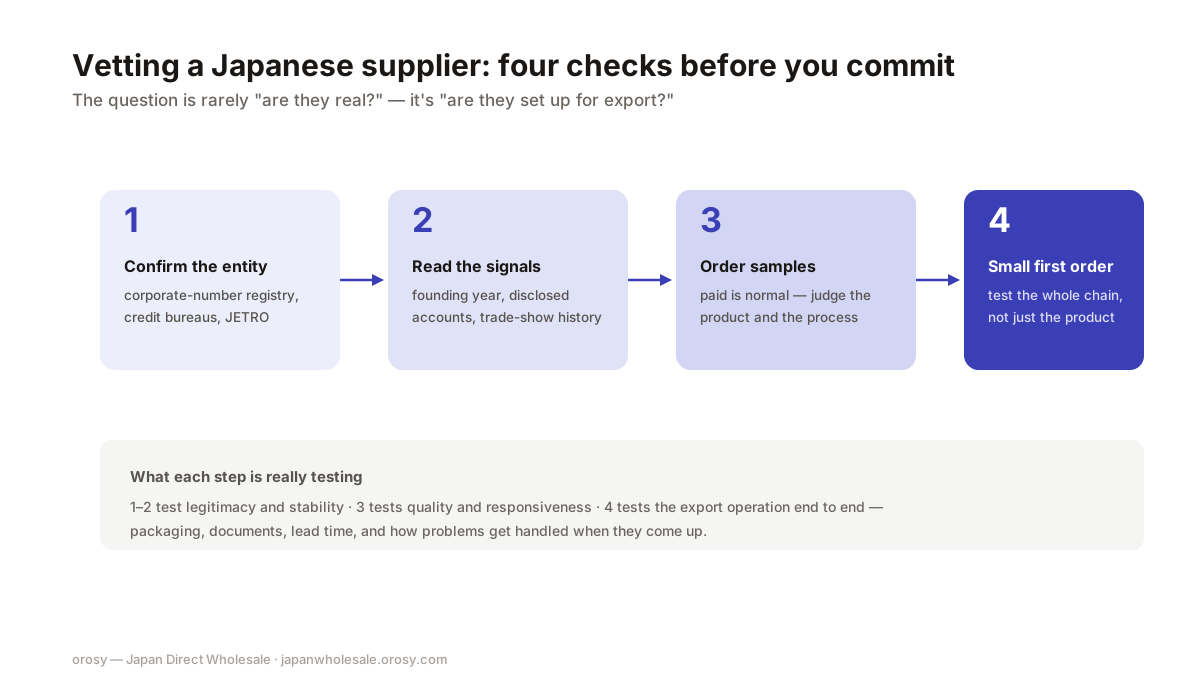
If you have sourced from other markets, you arrive with a checklist built for those markets: scan for scam patterns, demand references, assume the worst until proven otherwise. That posture is reasonable in some sourcing contexts, but it can lead you to misread Japan.
Japanese B2B commerce runs on long-term, relationship-based trust. Decisions are shaped by concepts like shinrai (trust) and giri (a sense of obligation), and partnerships are typically formed through introductions rather than cold outreach. (KizunaX — Japanese B2B business culture) That has two practical consequences for a first-time foreign buyer. First, outright supplier fraud is not the default risk — you're dealing with companies that have often sold to the same domestic accounts for decades. Second, and more usefully, the friction you'll likely hit isn't dishonesty; it's that the maker has simply never sold abroad and isn't organized to do so.
So the more accurate framing isn't "is this supplier legit?" but "is this supplier real, and are they set up to export?" The first question has a fast, official answer. The second is an operational gap you can plan for.
Step 1 — Confirm the company legally exists
Before money or a contract enters the picture, you can verify that a Japanese company is a registered legal entity — at no cost, from anywhere.
The Japanese National Tax Agency runs the Corporate Number Publication Site (法人番号公表サイト), a public database where every registered organization is assigned a unique 13-digit Corporate Number. The number is designated automatically — companies don't apply for it — and three core data points are published for each: the organization's trade name, its head-office address, and the number itself, plus the history of any name or address changes. (NTA — About Corporate Numbers) The site has an English interface, and you can search by company name, address, or the number directly. (NTA Corporate Number Publication Site, English)
A few practical notes:
- The English search only returns companies that registered their details in English. Many smaller makers registered only in Japanese, so a "no result" in English may just mean you need to search the Japanese name.
- This confirms legal existence and registered identity — that the entity is real and matches the name and address you were given. It's a fast first filter, not a full background check.
If the name and address a prospective supplier gave you line up with the registry, you've cleared the most basic — and most important — bar.
Step 2 — Go deeper with a credit-research agency
For a supplier you're about to commit real volume to, legal existence isn't enough; you want a read on financial health and operating history. Japan has an unusually mature infrastructure for exactly this.
Two long-established credit-research agencies dominate, and Japanese businesses routinely refer to them as the "big two":
- Teikoku Databank (TDB) — founded in 1900, it holds millions of business records and publishes corporate credit reports with a TDB rating that functions as a widely recognized standard for company credit assessment in Japan. Notably, TDB has long maintained a "visit and confirm" practice — field researchers physically visiting companies to gather information on site. (Teikoku Databank — Corporate Credit Research)
- Tokyo Shoko Research (TSR) — the other major agency, widely used for credit risk and due-diligence work, with particular depth on small and mid-size companies. (comparison of the two agencies)
A report from either gives you a structured view — company profile, financials where available, and a credit rating — that you can't assemble from a website. For a first small order this is usually overkill, but when you're weighing a meaningful ongoing commitment, it's the standard tool Japanese companies themselves rely on.
Step 3 — Use JETRO as a public, neutral resource
You don't have to navigate Japan alone. JETRO (the Japan External Trade Organization) is a government-related body whose mandate is to promote trade between Japan and other countries — and it works in both directions, supporting overseas buyers, not just Japanese exporters.
JETRO arranges meetings between Japanese companies and international buyers, runs business-matching platforms, and offers consultations on trade practices, legal matters, and regulatory questions, with roughly 70 overseas offices staffed by advisors. (JETRO — activities, JETRO USA services) For a first-time buyer, it's useful less as a verification database and more as a neutral party you can ask "is this a normal way to do this?" — and as a channel that can surface export-oriented Japanese companies.
How to read Japanese trust signals
Once a company checks out as real, you'll want to assess it the way a Japanese counterpart would. The signals that carry weight here aren't always the ones a US buyer is trained to look for.
Founding year. Longevity is a meaningful signal in Japan, where a large share of makers and ton'ya (wholesalers) are long-tenured, multi-decade businesses. A founding date stretching back decades isn't decoration — it reflects a company that has survived on repeat domestic relationships.
Disclosed relationships. Japanese companies often publish their principal clients, banks, and affiliations. This openness about who they already do business with is a deliberate trust signal — it invites you to triangulate their reputation through known names rather than asking them to prove themselves cold.
Trade-show history. A track record of exhibiting at established fairs — gift, lifestyle, food, or category-specific shows — tells you a company invests in being found and is comfortable meeting new buyers face to face. In a culture where introductions and in-person trust-building matter, a consistent exhibition history marks a maker that is at least partly outward-facing. (B2B trade-show etiquette in Japan)
Here's the reframe that saves first-time buyers the most grief: when something feels "off" — slow replies, a Japanese-only site, no export paperwork — the explanation is far more often export-inexperience than risk. A maker that has spent decades perfecting a product for the domestic market, selling through long-standing local accounts, has had no reason to build an English sales motion. That's a structural gap, not a red flag. Vetting Japanese suppliers is mostly about telling those two things apart.
Requesting samples and designing a small first order
Once a supplier looks solid, test the product and the relationship at low stakes.
Samples
Expect to pay for samples. Among Japanese suppliers, a nominal charge covering production and shipping is normal — particularly for finished or specialized goods — and reputable suppliers frequently credit the sample cost against a later bulk order. (Wise — how to find suppliers in Japan) Treat a paid sample as a sign of a serious supplier, not a hurdle. A few norms to plan around:
- You typically cover sample shipping, including international freight.
- Lead times run longer than you may expect — sample and production timelines in the 30–90 day range are common, and peak seasons stretch them further. (Wise)
- Inquire from a verifiable business email. Japanese wholesale is strictly B2B; suppliers generally won't quote individuals without a business identity, so a company domain and clear introduction smooth the first contact. (Ichiba.net — finding reliable Japanese suppliers)
A deliberately small first order
Your first order is a test, and it should be sized like one. The goal is to validate three things at once: that the product is what the sample promised, that the supplier can fulfill an export order, and that the working relationship is comfortable.
- 1
Confirm the minimum, then start at it
Minimum order quantities (MOQs) are set for the Japanese domestic market, so they can be higher than a foreign buyer wants for a first test. Ask directly, and where there's flexibility, start at the floor rather than over-committing.
- 2
Pin down Incoterms and who clears customs
Agree explicitly on terms (EXW, FOB, DDP, and so on) so it's unambiguous who arranges freight and who is responsible for customs clearance and duties. This is the single most common source of first-order surprises.
- 3
Build a full landed-cost view
Add product cost, international freight, and import duties into one figure before you decide. Duties apply on Japanese imports regardless of order size, so model them from the start — not after the goods ship.
- 4
Agree on lead time and a reorder path
Confirm the production and shipping timeline in writing, and ask what a repeat order looks like. A clean small order plus a clear reorder process is the foundation you actually want.
A small, clean first order does more than limit downside — it gives a Japanese supplier the early proof point that you are a reliable counterpart, which in a relationship-driven market is what unlocks better terms over time.
Handling the language gap, practically
The language barrier is real, but it's an operational detail to manage, not a reason to walk away — and certainly not a knock on the supplier. A maker communicating in Japanese is doing business in their own market; the burden of bridging sits reasonably with the side that wants to import. A few tactics that work:
- Write simple, literal English. Short sentences, one ask per message, no idioms — this improves the accuracy of any machine translation on the receiving end.
- Keep a small library of standard phrases. A reusable, clearly translated set of lines — requesting a quote, confirming MOQ, asking about Incoterms, requesting a sample — keeps your communication consistent. Modern translation tools handle plain B2B phrasing well.
- Read PDF catalogs structurally. Japanese wholesale catalogs are often PDFs built for domestic buyers. You rarely need every word — focus on the SKU grid, product codes, case-pack quantities, and price columns, which are mostly numeric and survive translation cleanly.
- Use introductions where you can. Because Japanese business leans on introductions, a warm intro — via JETRO, a trade-show contact, or an existing relationship — does more to smooth communication than any amount of perfect translation. (KizunaX)
None of this requires fluency — just patience and a little structure.
Doing it yourself vs. using a pre-vetted pool
Everything above is doable. It's also, honestly, a lot — and it repeats for every single supplier. Each new maker means another registry check, potentially another credit report, another sample cycle, another Incoterms negotiation, another landed-cost model, another translation thread. For a buyer assembling a Japanese assortment of any breadth, that vetting load compounds fast.
There's a different shape to the problem worth weighing. If you've already mapped how Japanese supply reaches US buyers — see our guide on how to source Japanese products wholesale in the US — you'll recognize the core trade-off: the routes with the most direct access also load the most operational work onto you, and vetting is a big part of that load.
One way to remove the repeated vetting is to work from a pool of suppliers that has already been contracted and onboarded by a sourcing partner. Instead of you running existence checks, credit reads, and export-readiness assessments supplier by supplier, that work has been done upstream — and what reaches you is a roster already cleared to transact. You trade some hands-on control for a large reduction in per-supplier overhead. For buyers building breadth rather than a single deep relationship, that's often the right trade.
orosy — Japan Direct Wholesale
orosy is built around removing exactly this repeated work. Rather than vetting Japanese suppliers one at a time, you draw from a base of Japanese brands and suppliers contracted directly by orosy — 4,000+ suppliers, over 1 million products, and 20,000+ buyers on the marketplace, with the company founded in 2018. The onboarding, the supplier relationships, and the cross-border operation sit on orosy's side: orosy buys at Japanese wholesale prices through those direct relationships, and your pricing is built on that purchasing power. orosy handles sourcing, customs, and international logistics, while duties and freight pass through, billed at cost, so your landed-cost model stays predictable. The verification, language, and export-readiness gaps this article walks through are handled before a product ever reaches your screen.
FAQ
How do I check whether a Japanese supplier is a real, registered company?
Use the Japanese National Tax Agency's Corporate Number Publication Site, a public database with an English interface that anyone can search at no cost. Every registered company has a 13-digit Corporate Number, and the site lists the legal name and head-office address tied to it. If the name and address a supplier gave you match the registry, the entity legally exists. The English search only returns companies that registered details in English, so a smaller maker may need to be searched by its Japanese name.
Is supplier fraud a big risk when sourcing from Japan?
It's typically not the primary risk. Japanese B2B commerce is heavily relationship- and trust-based, and many makers have sold to the same domestic accounts for decades. The more common challenge is export-inexperience — a supplier that is entirely legitimate but simply isn't set up to sell abroad, with no English materials or export paperwork. That's an operational gap to plan around, not a sign of dishonesty.
Should I expect to pay for samples from a Japanese supplier?
Usually yes. A nominal charge covering production and shipping is normal, especially for finished or specialized goods, and many reputable suppliers credit the cost against a later bulk order. You generally also cover sample shipping. Treat a paid sample as a sign of a serious B2B supplier, and budget for lead times that often run from about 30 to 90 days.
How do credit-research agencies like Teikoku Databank fit into vetting?
For a supplier you're about to commit significant volume to, Japan's major credit-research agencies — Teikoku Databank and Tokyo Shoko Research — publish company reports with financial profiles and credit ratings, and Teikoku Databank's researchers physically visit companies to gather information. That gives you a depth of due diligence a website can't. For a small first order it's usually more than you need, but for an ongoing commitment it's the standard tool Japanese companies themselves use.
Sources
- National Tax Agency Corporate Number Publication Site (English): https://www.houjin-bangou.nta.go.jp/en/index.html
- National Tax Agency — About Corporate Numbers: https://www.houjin-bangou.nta.go.jp/en/setsumei/
- Teikoku Databank — Corporate Credit Research: https://www.tdb-en.jp/services/ccr.html
- Teikoku Databank vs. Tokyo Shoko Research comparison: https://www.ipros.com/en/news/detail/152818/
- JETRO — activities and support for business: https://www.jetro.go.jp/en/jetro/activities/business/
- JETRO USA — services: https://www.jetro.go.jp/usa/japan-external-trade-organization-services.html
- KizunaX — Japanese B2B business culture and trust: https://kizuna-x.com/article/japanese-b2b-business-culture/
- B2B Insiders — navigating trade shows in Japan: https://jp.b2b-insiders.com/blog/navigating-international-trade-shows-in-japan-a-comprehensive-guide-for-b2b-professionals
- Wise — how to find suppliers in Japan: https://wise.com/us/blog/how-to-find-suppliers-in-japan
- Ichiba.net — how to find reliable suppliers from Japan: https://ichiba.net/en/blog/how-to-find-reliable-suppliers-from-japan
orosy — Japan Direct Wholesale
Choose from Japan’s full shelf — not someone else’s catalog.
orosy connects US buyers to 5,000+ Japanese brands and 200,000+ products, and handles sourcing, customs, and international logistics — while duties and freight pass through, billed at cost.
Join the waitlistWritten by
Kanji NoguchiFounder, orosy
Founder of orosy. Building direct wholesale access between Japanese brands and US buyers.
Keep reading
Sourcing & Procurement
Adding a Japanese Line to Your Card: A Playbook for Sales Reps & Agencies
June 8, 2026 · 7 min read
Sourcing & Procurement
Adding Japanese Supply to Your B2B Marketplace: A Playbook for Platform Operators
June 8, 2026 · 8 min read
Sourcing & Procurement
Broadening Your Japanese Line: A Playbook for Regional Importers
June 8, 2026 · 8 min read