Sourcing & Procurement
Adding Japanese Rewards to Your Points Catalog: A Playbook for Loyalty & Redemption Programs
A playbook for loyalty, rewards, and redemption programs that want to add desirable Japanese rewards to their points catalog — why redemption rate is the metric that matters, how aspirational rewards lift engagement, and how to integrate and fulfill Japanese SKUs reliably without running an import operation.


On this page
Key takeaways
- Your program lives or dies on redemption. Roughly half of loyalty rewards go unredeemed, and the enrollment-to-engagement gap is the industry's biggest structural problem — a catalog members actually want to redeem from is the fix.
- Aspirational rewards drive that. Members engage and redeem when the catalog has things they genuinely want, not another generic gift card. Distinctive Japanese products are exactly that kind of pull.
- A redeemed reward that doesn't arrive is worse than no reward. It breaks the program's core promise, so reliable fulfillment is non-negotiable — more so than in one-off gifting.
- Integration matters as much as the product. Japanese rewards have to plug into your points catalog cleanly — by API, eGift-ready — not as a manual side process.
- You don't have to import to offer them. One source that carries the breadth, the integration, and the cross-border fulfillment lets you enrich the catalog without an import operation.
The situation: your program lives on redemption
Every loyalty and rewards program has one health metric above the rest: redemption. And the numbers are sobering — roughly half of all loyalty rewards go unredeemed, healthy programs run active redemption rates of only 20–30%, and consumers leave an estimated $10 billion in unspent rewards unclaimed every year. (Points Program Redemption Rate Benchmarks, Rivo, Loyalty Program Statistics, Queue-it) The deeper issue is the enrollment-to-engagement gap: people enroll in many programs and actively use few. (Queue-it / Deloitte)
What moves those numbers is desirability. Members engage and redeem when the catalog holds rewards they genuinely want — and programs that offer more aspirational, tiered rewards see materially higher engagement and ROI. (Tiered Loyalty Program Statistics, Rivo) A catalog of the same generic gift cards everyone offers doesn't pull; a catalog with something distinctive does. Distinctive Japanese products are a clean way to add that pull.
This is a practical playbook for adding Japanese rewards to your catalog without it becoming a sourcing project. It assumes you run a real program — a points catalog, members, redemption operations, an integration layer — and works inside that reality. For the supply-side map, our guide to sourcing Japanese products wholesale in the US covers the routes; this piece is about doing it for a rewards catalog.
① Why Japanese products make strong rewards
Two reasons, and they map straight to redemption.
They're aspirational and distinctive. A reward only gets redeemed if a member wants it more than they want to keep their points. Japanese craft products — design goods, beauty, food, stationery — read as a desirable, considered reward rather than a default, which is exactly the pull that lifts redemption off the floor.
Demand is real and current. Japanese product has strong, growing US appeal — Japan's food and agricultural exports hit a record ¥1.70 trillion in 2025 with the US the top destination, up 13.7%. (Nippon.com / MAFF data) So Japanese rewards feel current and sought-after to your members, not obscure.
② The playbook
Step 1 — Diagnose the redemption gap, not just the enrollment number
Start with the metric that matters. Look at your redemption rate and where members stall — points earned but never spent, tiers no one reaches for, catalog pages no one opens. That tells you whether your problem is a catalog that doesn't pull (usually it is) and where adding desirable rewards would move the number. Enrollment is vanity; redemption is the program.
Step 2 — Add aspirational rewards, not more generic ones
The reflex is to add more of the same — another gift card, another commodity item. That doesn't lift redemption, because it doesn't add desire. Add rewards members genuinely want: distinctive, aspirational items that make spending points feel like getting something special. A curated Japanese selection is a strong addition precisely because it isn't what every other program offers.
Step 3 — Integrate into your catalog cleanly
A reward your members can't smoothly redeem doesn't count. Japanese rewards have to plug into your points catalog the way the rest of it works — by API, so listings, availability, and redemption flow through your existing system, and eGift-ready where your program runs on digital fulfillment. The goal is a connector your team maintains, not a manual side process that breaks at scale.
Step 4 — Make fulfillment reliable, because it's the program's promise
This is the step that's even more critical for a program than for one-off gifting. When a member redeems hard-earned points and the reward arrives late or not at all, you haven't just lost an order — you've broken the core promise the entire program rests on, and that member's trust in every reward. The timing risk lives in cross-border fulfillment, so confirm who clears customs and guarantees delivery before a Japanese reward goes live in the catalog. Redeemed must mean delivered.
Step 5 — Value the reward on a real cost basis
Rewards are funded from a points liability, so each reward's true cost has to be known to set its point price and protect program economics. Model the landed cost: under the 2025 US–Japan framework, most Japanese consumer goods land at roughly 15% duty, inclusive of the MFN rate rather than added to it, set by each item's HTS classification — so it varies by product. Duties are ad valorem, so the rate holds at any volume. (Congressional Research Service, Federal Register notice) When a source passes duties and freight through transparently, your cost-per-redemption is predictable; our customs, duties, and logistics walkthrough shows how to build it.
Step 6 — Measure redemption lift, then widen
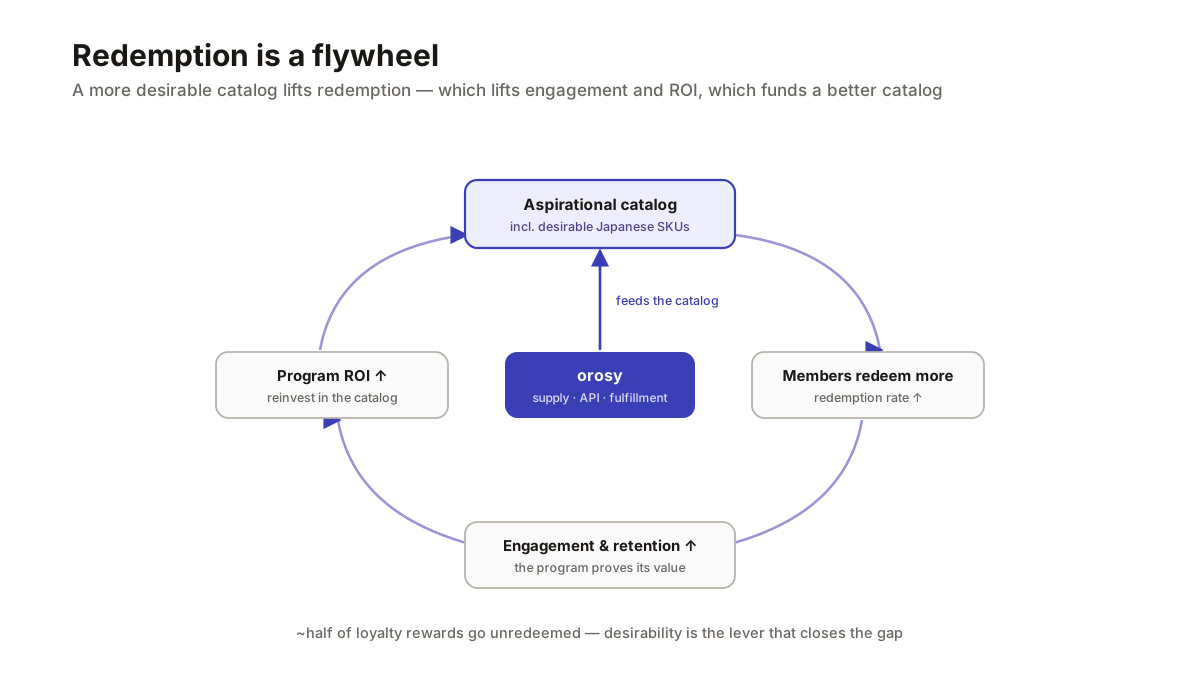
Treat the addition as a test against your core metric. Watch whether the Japanese rewards lift redemption and engagement among the members and tiers you targeted, prune what doesn't pull, and widen the selection on the lift. The flywheel does the rest: a more desirable catalog raises redemption, which raises engagement and ROI, which justifies investing in an even better catalog.
③ Three common ways this goes wrong
Do this
- Add genuinely aspirational rewards that lift redemption, integrated into your catalog by API / eGift-ready.
- Guarantee fulfillment before a reward goes live — redeemed must mean delivered, because it's the program's promise.
- Track redemption and engagement lift, and widen the selection on the metric.
Avoid this
- Adding more generic rewards. Another commodity gift card doesn't add desire, so it doesn't lift redemption — the metric that defines the program.
- Letting a redeemed reward fail to fulfill. A member who spent points on a reward that never arrived loses trust in the entire program, not just that item.
- Treating 'Japan' as a token SKU rather than a curated, desirable set. A single novelty item doesn't move redemption; a curated, wanted selection does.
The middle failure mode is the one with outsized damage. In gifting, a botched delivery disappoints one recipient; in a rewards program, a botched redemption tells a member their points — the whole basis of their participation — can't be trusted. That's why fulfillment reliability isn't a feature of a rewards catalog; it's the foundation under it.
orosy — Japan Direct Wholesale
If you'd rather enrich your catalog than build an import operation, this is the gap orosy is built to fill. The name comes from the Japanese word orosu (卸す), "to wholesale." Founded in 2018, orosy connects buyers to a wide breadth of Japanese supply — 4,000+ Japanese brands and suppliers, over 1 million products, and 20,000+ buyers — and is an equity-method affiliate of giftee Inc. (Tokyo Stock Exchange Prime: 4449), whose business is built around gifting and digital rewards. For a points catalog, that means a broad pool of desirable Japanese rewards you can integrate by API rather than a handful of novelty SKUs, with orosy handling sourcing, customs, and international logistics so redeemed rewards actually arrive. Duties and freight pass through, billed at cost, so your cost-per-redemption stays honest. It's a more desirable catalog and reliable fulfillment, without the import operation behind it.
If desirable Japanese rewards fit where your program is headed, you can join the waitlist:
FAQ
Why add Japanese products to a rewards catalog?
To lift redemption, which is the metric a program lives on — roughly half of loyalty rewards go unredeemed, and that's usually a desirability problem. Members redeem when the catalog holds something they genuinely want, and distinctive Japanese products are aspirational and current, so they add the pull that generic gift cards don't.
How do Japanese rewards integrate into a points catalog?
By API, so listings, availability, and redemption flow through your existing system, and eGift-ready where your program runs on digital fulfillment. The aim is a connector your team maintains rather than a manual side process — the integration matters as much as the product, because a reward members can't smoothly redeem doesn't count.
What happens if a redeemed reward doesn't arrive?
You break the program's core promise. A member who spends hard-earned points on a reward that arrives late or not at all loses trust in every reward, not just that one — which is why fulfillment reliability matters even more for a rewards program than for one-off gifting. Confirm who clears customs and guarantees delivery before a Japanese reward goes live: redeemed must mean delivered.
How do I price Japanese rewards in points?
On their real landed cost, since rewards are funded from a points liability. Most Japanese consumer goods land at roughly 15% duty, inclusive of the MFN rate and set by each item's classification, so it varies by product; duties are ad valorem so the rate holds at any volume. When a source passes duties and freight through transparently, your cost-per-redemption is predictable and you can set point prices that protect program economics.
How does orosy fit a loyalty or redemption program?
As the reward-supply and fulfillment layer. orosy connects you to a broad breadth of Japanese supply — 4,000+ brands and over 1 million products — that you integrate into your catalog by API, and it handles sourcing, customs, and international logistics so redeemed rewards reliably arrive, with duties and freight passing through at cost. As an equity-method affiliate of giftee Inc., a gifting and digital-rewards business, it fits the rewards context; you keep the program and the member relationship, orosy provides the desirable Japanese rewards and the cross-border fulfillment.
Sources
- Points Program Redemption Rate: Industry Benchmarks (half unredeemed, 20–30% active), Rivo: https://www.rivo.io/blog/points-program-redemption-rate
- Tiered Loyalty Program Statistics (engagement & ROI of aspirational/tiered rewards), Rivo: https://www.rivo.io/blog/tiered-loyalty-program-statistics
- Loyalty Program Statistics ($10B unclaimed, enrollment-engagement gap), Queue-it: https://queue-it.com/blog/loyalty-program-statistics/
- Japan's Food Exports Rise to ¥1.7 Trillion in 2025 (US top destination, +13.7%), Nippon.com (MAFF data): https://www.nippon.com/en/japan-data/h02696/
- US Tariffs and the 2025 US–Japan Framework Agreement, Congressional Research Service: https://www.congress.gov/crs-product/IN12608
- Implementing Certain Tariff-Related Elements of the United States–Japan Agreement, Federal Register: https://www.federalregister.gov/documents/2025/09/16/2025-17908/implementing-certain-tariff-related-elements-of-the-united-states-japan-agreement
orosy — Japan Direct Wholesale
Choose from Japan’s full shelf — not someone else’s catalog.
orosy connects US buyers to 5,000+ Japanese brands and 200,000+ products, and handles sourcing, customs, and international logistics — while duties and freight pass through, billed at cost.
Join the waitlistWritten by
Kanji NoguchiFounder, orosy
Founder of orosy. Building direct wholesale access between Japanese brands and US buyers.
Keep reading
Sourcing & Procurement
Adding a Japanese Line to Your Card: A Playbook for Sales Reps & Agencies
June 8, 2026 · 7 min read
Sourcing & Procurement
Adding Japanese Supply to Your B2B Marketplace: A Playbook for Platform Operators
June 8, 2026 · 8 min read
Sourcing & Procurement
Broadening Your Japanese Line: A Playbook for Regional Importers
June 8, 2026 · 8 min read