Sourcing & Procurement
Kakeritsu: How Japanese Wholesale Pricing Actually Works (a Guide for US Buyers)
An inside look at how Japanese wholesale prices are set — the kakeritsu (掛率) system, where the price comes down from the retail tag instead of up from cost, how distribution layers stack, and how to read a Japanese quote as a US buyer.

On this page
- Why a Japanese quote feels "backwards" to a US buyer
- How kakeritsu works: the math runs downward
- Why this system exists: the suggested-retail-price culture
- How distribution layers stack the kakeritsu
- How to read a Japanese quote (and a note on negotiation)
- From kakeritsu to landed cost: the part the percentage doesn't show
- Where orosy fits
- FAQ
Key takeaways
- Japanese wholesale prices are usually expressed as kakeritsu (掛率) — a percentage of the retail price, not a markup over cost. The math runs downward from the tag, not upward from the factory.
- A '60% kakeritsu' means you buy at 60% of the suggested retail price; the remaining 40% is your gross margin if you sell at that retail price.
- Japan's manufacturer-suggested-retail-price (建値) culture is what makes this work: a reference retail price anchors the whole chain, and the kakeritsu divides the spread between maker, wholesaler, and retailer.
- Each distribution layer takes its own slice of kakeritsu, so a two-step wholesale chain leaves the retailer less margin than buying closer to the maker.
- When you read a Japanese quote, a kakeritsu figure tells you your margin at a glance — but the actual number moves with relationship depth, volume, and category, so treat any single percentage as illustrative, not a fixed rate.
Why a Japanese quote feels "backwards" to a US buyer
If you've sourced domestically in the US, you've internalized a particular mental model: a supplier has a cost, adds a markup, and that's your wholesale price. You then mark that up to set your retail price. Price builds upward — cost, then wholesale, then retail.
The first time a US buyer reads a Japanese price list, it can feel inverted, because it is. Japanese wholesale pricing typically starts from the retail price and works downward. The supplier (or the category convention) sets a suggested retail price, and the wholesale price is quoted as a fraction of it — the kakeritsu. Dictionaries translate the word plainly as "ratio of wholesale price to retail price." (JapanDict — 掛け率)
So instead of being told "this costs ¥600 wholesale," you're often told "this is roku-kake" — six-tenths — and expected to know the retail price to find the wholesale price. It's a small difference in framing that changes how you read every quote and calculate every margin. The rest of this guide unpacks it.
How kakeritsu works: the math runs downward
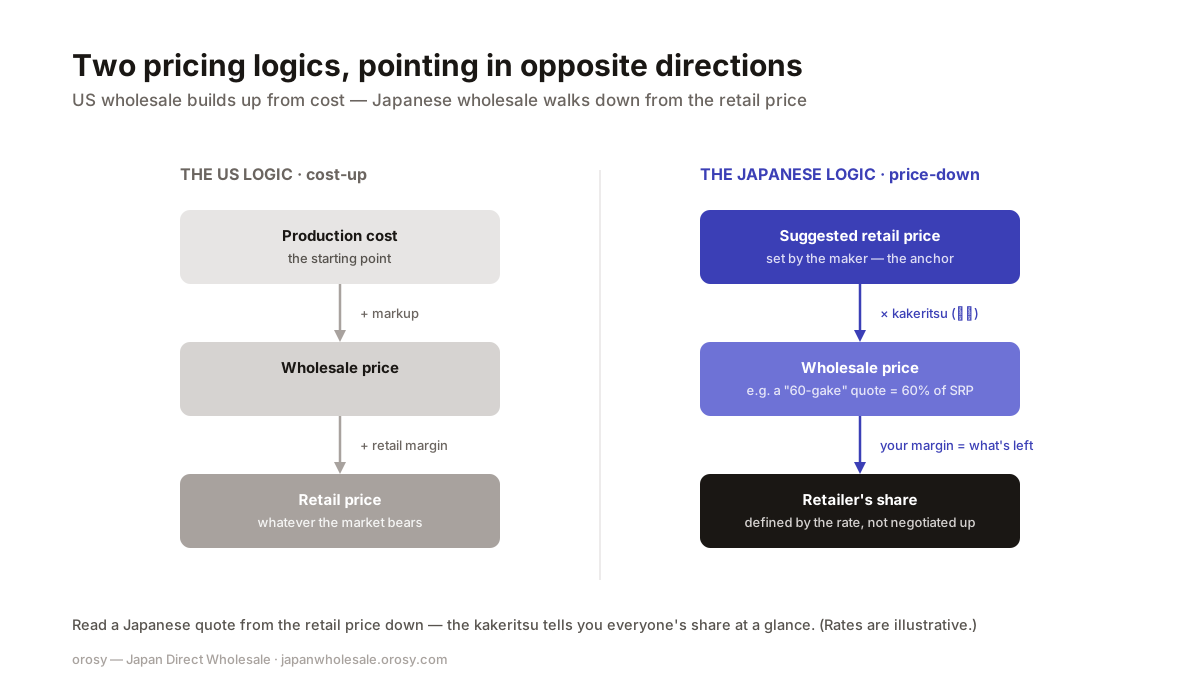
The core formula is short, and it's worth committing to memory because almost everything in Japanese B2B pricing hangs off it.
In Japanese trade, the retail price is called jōdai (上代) and the wholesale price is called gedai (下代). The kakeritsu connects them:
- Wholesale price (gedai) = Retail price (jōdai) × kakeritsu
- Kakeritsu = Wholesale price ÷ Retail price
These relationships are standard in Japanese wholesale-trade explainers. (DEXTRE — kakeritsu and wholesale pricing, Japanese-language source, Tokubai Retail Guide — kakeritsu basics, Japanese-language source)
Here is a worked example for illustration only — the percentage is invented to show the mechanics, not to suggest a market rate:
| Field | Value (illustrative) | How it's derived |
|---|---|---|
| Suggested retail price (jōdai / 上代) | ¥3,000 | Set by the maker or category convention |
| Kakeritsu (掛率) | 60% (roku-kake) | Quoted by the supplier |
| Your wholesale price (gedai / 下代) | ¥1,800 | ¥3,000 × 0.60 |
| Your gross margin at full retail | ¥1,200 (40%) | ¥3,000 − ¥1,800 |
Notice what the kakeritsu does in one number: it simultaneously tells you your cost (¥1,800) and your margin (40%), as long as you sell at the suggested retail price. That's the quiet efficiency of the system — a single figure communicates the whole economics of the deal, because the retail price is the shared anchor everyone is working from.
The naming follows a simple verbal pattern. A kakeritsu spoken as nana-kake is 70% (seven-tenths); roku-kake is 60%; go-kake is 50%. Lower kakeritsu means a lower wholesale price and a fatter retail margin; higher kakeritsu means you pay more for the goods and keep less.
Why this system exists: the suggested-retail-price culture
Kakeritsu only works because there's a retail price to take a fraction of. That anchor comes from Japan's long-standing manufacturer-suggested-retail-price culture, historically administered through a practice called tatene (建値) — a maker-set reference price for each stage of distribution, which shows up at the shelf as the kibō kouri kakaku (希望小売価格), the "suggested retail price." (Orange POS glossary — 建値 / suggested retail price, Japanese-language source)
Two clarifications matter for a US buyer, both grounded in the Japanese sources:
- The suggested retail price is a reference, not a mandate. Outside a narrow set of resale-price-maintenance categories (publications and a few others), a Japanese maker generally cannot legally dictate the price a retailer sells at; the retailer sets its own shelf price. (Orange POS glossary, Japanese-language source)
- Some categories have moved to open pricing (ōpun kakaku, オープン価格), where the maker publishes only a wholesale price and no suggested retail price at all. In those cases there's no shared retail anchor, which is precisely why kakeritsu negotiation gets harder — there's no agreed jōdai to take a percentage of. (NLI Research — economic analysis of open-pricing adoption, Japanese-language source)
So when a Japanese quote leans on kakeritsu, it's implicitly leaning on a suggested retail price doing the anchoring. When a category has gone open-price, expect plain wholesale figures and more back-and-forth instead. Knowing which world a given product lives in tells you what kind of quote to expect.
How distribution layers stack the kakeritsu
This is where the kakeritsu system connects to the structural reality of Japanese sourcing — and to a point we made in our guide to the five ways US buyers source Japanese products wholesale: every intermediary in the chain takes a slice.
In Japanese distribution, the wholesale layer itself is often split. A ton'ya (問屋, wholesaler) near the maker is a primary wholesaler (ichiji ton'ya, 一次問屋); a wholesaler that buys from that wholesaler and resells onward is a secondary wholesaler (niji ton'ya, 二次問屋). Each layer applies its own kakeritsu, and the effect compounds as you move further from the maker.
Here's the same illustrative ¥3,000 product viewed through two different chain shapes. The percentages are invented to show how layering compounds, not to state real rates:
| Chain shape | Maker → you | Your wholesale cost (illustrative) | Your margin at ¥3,000 retail |
|---|---|---|---|
| Closer to the maker | Maker → primary wholesaler → you | ≈ ¥1,800 (≈60% kakeritsu) | ≈ ¥1,200 (≈40%) |
| Longer chain | Maker → primary → secondary → you | ≈ ¥2,100 (each layer adds its slice) | ≈ ¥900 (≈30%) |
The principle, not the specific numbers, is the takeaway: the more wholesale layers sit between you and the maker, the higher your effective kakeritsu climbs and the thinner your margin gets at the same shelf price. This is the same "selection is decided upstream of you" dynamic from the sourcing guide, seen from the pricing side. There, extra layers narrowed what you could see; here, they narrow what you get to keep.
For an overseas buyer, this matters doubly, because reaching closer to the maker is exactly what's operationally hard from outside Japan — the language, the introductions, the minimums. The distance that makes the relationship hard to build is the same distance that's quietly stacking kakeritsu into your cost.
How to read a Japanese quote (and a note on negotiation)
Once you understand the framing, a Japanese price sheet becomes legible. A few practical reading rules:
- See a kakeritsu figure? Find the jōdai (retail price) first. The kakeritsu is meaningless without the retail anchor it's a percentage of. "60%" alone isn't a price; "60% of a ¥3,000 jōdai" is ¥1,800.
- Lower kakeritsu is better for you. A 50% kakeritsu leaves you more retail margin than a 65% kakeritsu on the same item. Train your eye to read the number as "the share I'm paying," and your margin as the remainder.
- Watch for open-price items. If a sheet lists wholesale prices with no suggested retail, you're in open-pricing territory; you'll set your own retail and there's no shared jōdai to reason from.
- Distinguish jōdai (上代, retail) from gedai (下代, wholesale). If a quote uses these terms, jōdai is the tag and gedai is what you pay. Mixing them up inverts your entire margin calculation.
On negotiation, a cultural caveat from a US buyer's seat. The kakeritsu on a given product is not a single fixed number — Japanese-language trade explainers note the same item can carry different kakeritsu depending on the customer relationship, order volume, season, and market conditions. (DEXTRE, Japanese-language source) In practice, a deeper, longer relationship and larger, more consistent volume are the levers that tend to move kakeritsu in a buyer's favor — not one-off haggling. This is a general cultural pattern, not a guaranteed outcome or a rate you should expect; categories and suppliers vary widely, and any number you see should be treated as illustrative until your own supplier confirms it.
From kakeritsu to landed cost: the part the percentage doesn't show
There's one trap worth naming. A kakeritsu tells you your wholesale price in Japan — and nothing else. For a US buyer importing from Japan, that price is only the first line of your true cost. Import duties and international freight sit on top of it, and those are real in every route into the US market.
In other words: a favorable kakeritsu does not automatically mean a favorable landed cost. A 55% kakeritsu can land more expensively than a 65% kakeritsu once duties and freight are layered on, depending on weight, classification, and shipping mode. To compare like for like, carry the Japanese wholesale price through to a full landed-cost model — which is exactly what our guide to importing Japanese products: customs, duties, and logistics walks through. Read kakeritsu as the starting number, not the final one.
Where orosy fits
orosy was built on the supply-side reality behind everything above. The name comes from the Japanese verb orosu (卸す), "to wholesale" — and orosy buys at Japanese wholesale prices through direct, long-standing supplier relationships, with fewer intermediaries between the maker and you than a typical multi-layer import chain. Founded in 2018, the marketplace connects US buyers to a wide breadth of Japanese supply — 4,000+ Japanese brands and suppliers, over 1 million products, and 20,000+ buyers — and handles the sourcing, customs clearance, and international logistics on your behalf. The costs that don't disappear — duties and freight — pass through and are billed at cost, so your landed-cost model stays predictable rather than buried in a markup. Your pricing is built on that purchasing power, without you having to learn to read a kakeritsu sheet or assemble an import operation to get there.
FAQ
What does kakeritsu mean in Japanese wholesale?
Kakeritsu (掛率) is the wholesale price expressed as a percentage of the suggested retail price. A 60% kakeritsu means the wholesale price is 60% of the retail tag — so on a ¥3,000 item you'd buy at ¥1,800 and keep ¥1,200 (40%) if you sold at full retail. It's the reverse of cost-plus pricing: the math starts from the retail price and works downward.
How do I calculate a wholesale price from a kakeritsu?
Multiply the suggested retail price by the kakeritsu. Retail price (jōdai) × kakeritsu = wholesale price (gedai). For example, a ¥3,000 retail price at a 60% kakeritsu gives a ¥3,000 × 0.60 = ¥1,800 wholesale price. To go the other way, divide the wholesale price by the retail price to get the kakeritsu.
Why is Japanese wholesale pricing based on retail price instead of cost?
Because Japan has a strong manufacturer-suggested-retail-price culture (historically the tatene / 建値 system), there's usually a reference retail price for each product. That shared anchor lets the whole chain — maker, wholesaler, retailer — divide the spread using a single percentage (the kakeritsu) rather than each party rebuilding a price from cost. Note that the suggested retail price is a reference, not a legally binding mandate across the great majority of categories.
Does a good kakeritsu mean a cheap landed cost for a US importer?
No. A kakeritsu only describes your wholesale price inside Japan. Import duties and international freight are added on top when you bring goods into the US, and those depend on the product's classification, weight, and shipping mode — not on the kakeritsu. Always carry the Japanese wholesale price through to a full landed-cost model before comparing options.
Sources
- JapanDict — definition of 掛け率 (kakeritsu): https://www.japandict.com/%E6%8E%9B%E3%81%91%E7%8E%87
- DEXTRE — kakeritsu, jōdai/gedai, and wholesale pricing (Japanese-language source): https://dextre.app/ja/wholesale/24225/
- Tokubai Retail Guide — kakeritsu basics and calculation (Japanese-language source): https://retailguide.tokubai.co.jp/store/42954/
- Orange POS glossary — 建値 / manufacturer suggested retail price (Japanese-language source): https://orange-pos.jp/pos-media/glossary/%E5%BB%BA%E5%80%A4-%EF%BC%88%E3%83%A1%E3%83%BC%E3%82%AB%E3%83%BC%E5%B8%8C%E6%9C%9B%E5%B0%8F%E5%A3%B2%E4%BE%A1%E6%A0%BC%EF%BC%89
- NLI Research — economic analysis of open-pricing (オープン価格) adoption and the decline of the tatene system (Japanese-language source): https://www.nli-research.co.jp/files/topics/36752_ext_18_0.pdf
orosy — Japan Direct Wholesale
Choose from Japan’s full shelf — not someone else’s catalog.
orosy connects US buyers to 5,000+ Japanese brands and 200,000+ products, and handles sourcing, customs, and international logistics — while duties and freight pass through, billed at cost.
Join the waitlistWritten by
Kanji NoguchiFounder, orosy
Founder of orosy. Building direct wholesale access between Japanese brands and US buyers.
Keep reading
Sourcing & Procurement
Adding a Japanese Line to Your Card: A Playbook for Sales Reps & Agencies
June 8, 2026 · 7 min read
Sourcing & Procurement
Adding Japanese Supply to Your B2B Marketplace: A Playbook for Platform Operators
June 8, 2026 · 8 min read
Sourcing & Procurement
Broadening Your Japanese Line: A Playbook for Regional Importers
June 8, 2026 · 8 min read