Sourcing & Procurement
Sourcing Japanese Corporate Gifts at Scale: A Playbook for Gifting Teams
A playbook for corporate gifting teams, HR, and agencies that want to add authentic Japanese gifts to their program — why Japanese products make strong gifts, how to curate for giftability, and the non-negotiable of reliable on-time cross-border fulfillment, plus landed cost and measurement.


On this page
Key takeaways
- Corporate gifting is a large, growing program spend — and it's shifting from generic swag toward personalized, premium gifts that carry meaning. Japanese products fit that shift unusually well.
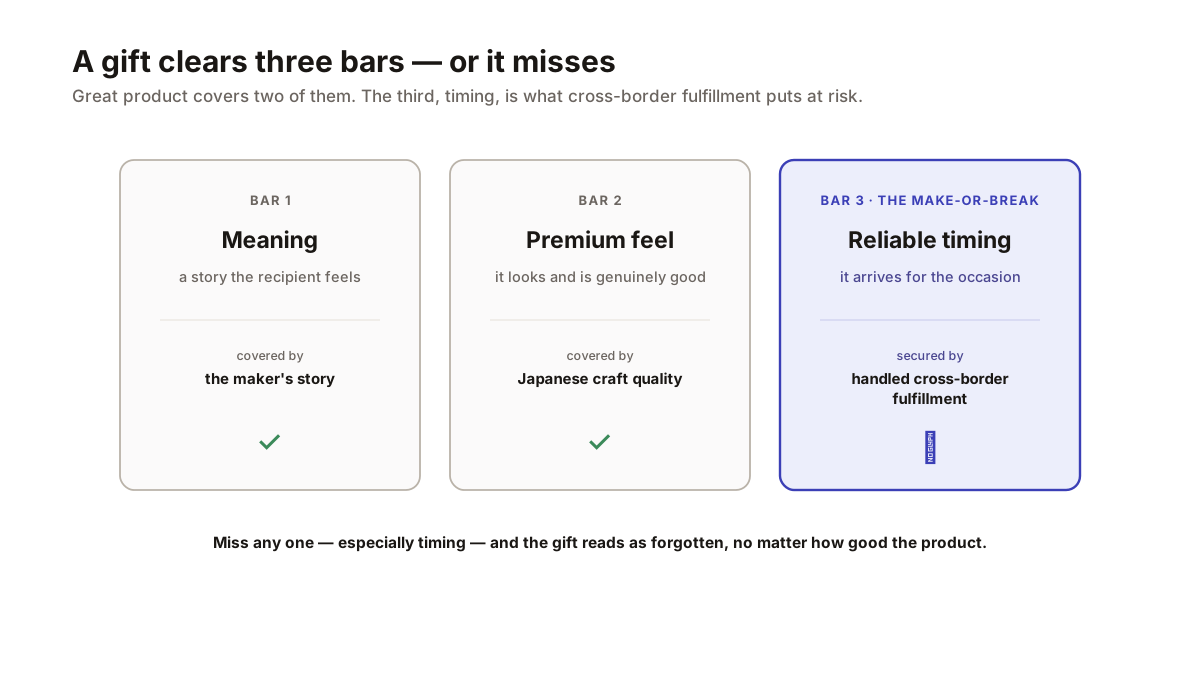
- A corporate gift has to clear three bars at once: meaning, premium feel, and reliable on-time delivery. Miss any one — especially the timing — and the gift fails, no matter how good the product is.
- Timing is the make-or-break that's specific to gifting. A gift tied to a date (a holiday, an onboarding, a client anniversary) that arrives late is worse than no gift. Cross-border fulfillment is where that risk lives.
- Curate for giftability, not catalog size. A tight, premium, story-rich selection gifts better than a sprawling 'Japan' menu.
- Don't run an import operation to do this. The reliable path is a supply source that carries the sourcing, customs, and freight so your gifts land on time.
The situation: gifting is bigger — and pickier — than ever
Corporate gifting is a serious line item. The market is set to grow from roughly $886.6 billion in 2025 to $956.9 billion in 2026 (about 7.9% growth) on its way past $1.3 trillion by 2030, and the United States accounts for over a third of global spend, with more than half of US companies running dedicated gifting programs. (Corporate Gifting Market, The Business Research Company, US corporate gift market share, Global Growth Insights)
What's changed is taste. Roughly 47% of companies are shifting toward personalized and premium gifts to make recipients feel genuinely valued, away from the logo-stamped commodity swag that everyone has learned to discard. (Global Growth Insights) That shift is the opening: a gift that carries craft and a story lands where a branded power bank doesn't.
This is a practical playbook for adding authentic Japanese gifts to your program without turning your team into importers. It assumes you run real gifting — occasions, recipient lists, budgets, deadlines — and works inside that reality. For the broader supply-side map, our guide to sourcing Japanese products wholesale in the US covers the routes; this piece is about doing it for gifts, where timing and presentation are everything.
① Why Japanese products make strong corporate gifts
Three reasons, and they line up with exactly what premium gifting now wants.
They carry a story. Many Japanese makers have refined their products for decades for a demanding domestic market — a teacup, a pen, a confection with real provenance. That story is the "reason this gift means something" that a generic item can't manufacture, and it's what a recipient remembers.
They feel premium without being loud. Japanese design tends toward understated quality — the gift reads as considered and tasteful rather than expensive-for-its-own-sake, which is the register most corporate gifting is reaching for.
Demand and familiarity are already there. Japanese product has sustained, growing pull in the US — Japan's food and agricultural exports hit a record ¥1.70 trillion in 2025 with the US the top destination, up 13.7% — so a Japanese gift feels desirable and current, not obscure. (Nippon.com / MAFF data)
② The playbook
Step 1 — Map your occasions and recipients first
Don't start with products. Start with your gifting calendar. List the occasions you actually gift around — holidays, client anniversaries, employee onboarding and milestones, event VIPs — and the recipient profile and budget band for each. That tells you what kind of gift each moment needs (a desk-worthy object vs a consumable vs a premium set) and, crucially, the date each one must land by. Those dates drive every later decision.
Step 2 — Curate for giftability, not catalog size
The instinct is to offer a broad "Japan" menu. Resist it. A great gift program is curated, not comprehensive. Pick a tight selection that fits your occasions and budget bands, choosing for giftability: does it look considered unwrapped, does it carry a story, does it suit the recipient. A focused set of genuinely giftable items beats a sprawling catalog the recipient has to choose from — and it's far easier to keep in stock for the dates that matter.
Step 3 — Lock the non-negotiable: reliable, on-time fulfillment
This is the step that's specific to gifting and the one teams underestimate. A gift is tied to a date. One that arrives after the event — the holiday passed, the new hire's first day is over — is worse than no gift, because it signals the opposite of "you're valued." And the timing risk lives almost entirely in cross-border fulfillment: customs, freight, and lead times you don't control if you're sourcing direct.
So before you commit a gift to an occasion, settle who guarantees the landed timeline. The reliable answer is a supply source that carries sourcing, customs, and international freight and can commit to delivery windows — not a chain of suppliers and forwarders you're hoping line up. Treat on-time delivery as a hard requirement, not a best-effort.
Step 4 — Personalize and present
Premium gifting is won on presentation. Two levers: the maker's story (a short card on who made it and why it's special turns an object into a gift), and packaging that feels intentional. Personalization — a recipient's name, a sender's note, a curated bundle for a tier of recipients — lifts perceived value markedly, which is exactly why nearly half of companies are moving that direction. Build these in rather than bolting them on at the end.
Step 5 — Model landed cost so your gift budgets hold
Gift budgets are fixed per recipient, so a cost surprise eats the program. Model the full landed cost before you commit. Under the 2025 US–Japan framework, most Japanese consumer goods are tariffed at roughly 15%, inclusive of the pre-existing MFN rate rather than stacked on it, with the exact figure set by each product's HTS classification — so it varies by item, not one flat number, and a few categories (some porcelain, for instance) sit higher. Duties are ad valorem, so the rate holds at any order size. (Congressional Research Service, Federal Register notice) Whether you owe duties directly depends on your route; our customs, duties, and logistics walkthrough shows how to build the per-gift landed figure so your per-recipient budget is real.
Step 6 — Measure response, refine each cycle
Gifting repeats on a calendar, so treat each cycle as a test. Capture what you can on recipient response — replies, redemption, follow-through — note which gifts landed and which didn't, and refine the curated set for the next occasion. The discipline mirrors the rest of your program; the new variable is the longer replenishment lead time on Japanese supply, which makes ordering ahead of each occasion the habit to build.
③ Three common ways this goes wrong
Do this
- Curate a tight, giftable, story-rich selection matched to your occasions and budgets.
- Treat on-time cross-border delivery as a hard requirement, with a source that commits to the landed timeline.
- Invest in the maker's story and intentional packaging — that's where premium gifting is won.
Avoid this
- Missing the occasion date. A gift that lands after the moment signals the opposite of care. Order ahead of the longer Japanese lead times and don't promise dates you can't guarantee.
- Treating 'Japan' as a theme rather than choosing genuinely premium, giftable products. A cherry-blossom sticker on a commodity item is a costume, not a gift.
- Ignoring duties until the invoice. Per-recipient budgets are fixed; an unmodeled tariff turns a planned gift into an over-budget one.
The first failure mode is the one unique to gifting. Sourcing problems in other businesses cost margin; in gifting they cost the point of the gift. A thoughtful present that arrives a week late doesn't read as "almost on time" — it reads as forgotten. Build the program so the date is never the variable in question.
orosy — Japan Direct Wholesale
If you'd rather curate gifts than run an import operation, this is the gap orosy is built to fill. The name comes from the Japanese word orosu (卸す), "to wholesale." Founded in 2018, orosy connects buyers to a wide breadth of Japanese supply — 4,000+ Japanese brands and suppliers, over 1 million products, and 20,000+ buyers — and is an equity-method affiliate of giftee Inc. (Tokyo Stock Exchange Prime: 4449). For a gifting program, that breadth means you can curate from nearly the full range of what Japan makes rather than a single importer's shortlist, while orosy handles the sourcing, customs, and international logistics — the part that otherwise puts your delivery dates at risk. Duties and freight pass through, billed at cost, so your per-recipient budgets stay honest.
If authentic Japanese gifts fit where your program is headed, you can join the waitlist:
FAQ
What makes Japanese products good corporate gifts?
Three things that match where premium gifting is heading: they carry a genuine maker's story, they read as understated and tasteful rather than loud, and they feel current because Japanese product already has strong, growing US demand. That combination lands where logo-stamped commodity swag doesn't.
How do I make sure Japanese gifts arrive on time?
Treat on-time delivery as a hard requirement and source from a supplier that carries customs and international freight and can commit to a landed timeline — not a chain of suppliers and forwarders you're hoping align. Order ahead of the longer Japanese replenishment lead times, and never promise a recipient a date you can't guarantee, because a late gift reads worse than none.
Should I offer a broad Japanese gift catalog or a curated set?
Curated. A great gift program is chosen, not comprehensive. A tight selection matched to your occasions and budget bands — picked for giftability and story — lands better and is far easier to keep in stock for the dates that matter than a sprawling 'Japan' menu.
How do import duties affect corporate gift budgets?
Model them up front, because per-recipient budgets are fixed. Under the 2025 US–Japan framework most Japanese consumer goods land at roughly 15%, inclusive of (not added to) the MFN rate, with the exact figure set by each item's HTS classification. Duties are ad valorem, so the rate holds at any size. If you source direct you carry it; either way it belongs in your per-gift landed cost before you set the program budget.
How does orosy fit a corporate gifting program?
orosy is the supply layer. It connects you to a broad breadth of Japanese supply — 4,000+ brands and over 1 million products — so you curate gifts from nearly the full range of what Japan makes, and it handles sourcing, customs, and international logistics, with duties and freight passing through at cost. You keep the parts that are yours — choosing occasions, curating, personalizing — while the delivery-date risk is carried by the source.
Sources
- Corporate Gifting Global Market Report ($886.6B→$956.9B, 7.9% CAGR), The Business Research Company: https://www.thebusinessresearchcompany.com/report/corporate-gifting-global-market-report
- US Corporate Gift Market share & program adoption, Global Growth Insights: https://www.globalgrowthinsights.com/market-reports/corporate-gift-market-116966
- Japan's Food Exports Rise to ¥1.7 Trillion in 2025 (US top destination, +13.7%), Nippon.com (MAFF data): https://www.nippon.com/en/japan-data/h02696/
- US Tariffs and the 2025 US–Japan Framework Agreement, Congressional Research Service: https://www.congress.gov/crs-product/IN12608
- Implementing Certain Tariff-Related Elements of the United States–Japan Agreement, Federal Register: https://www.federalregister.gov/documents/2025/09/16/2025-17908/implementing-certain-tariff-related-elements-of-the-united-states-japan-agreement
orosy — Japan Direct Wholesale
Choose from Japan’s full shelf — not someone else’s catalog.
orosy connects US buyers to 5,000+ Japanese brands and 200,000+ products, and handles sourcing, customs, and international logistics — while duties and freight pass through, billed at cost.
Join the waitlistWritten by
Kanji NoguchiFounder, orosy
Founder of orosy. Building direct wholesale access between Japanese brands and US buyers.
Keep reading
Sourcing & Procurement
Adding a Japanese Line to Your Card: A Playbook for Sales Reps & Agencies
June 8, 2026 · 7 min read
Sourcing & Procurement
Adding Japanese Supply to Your B2B Marketplace: A Playbook for Platform Operators
June 8, 2026 · 8 min read
Sourcing & Procurement
Broadening Your Japanese Line: A Playbook for Regional Importers
June 8, 2026 · 8 min read