Category Guides
J-Beauty Wholesale: Sourcing Japanese Skincare & Cosmetics for US Retail
A category guide for US beauty buyers and spa/salon distributors on sourcing Japanese skincare and cosmetics wholesale — what's driving J-beauty demand, how it differs from K-beauty, the MoCRA regulatory layer to plan for, and the sourcing routes and landed costs that come with the category.

On this page
- The demand is led by skincare — and it's specific
- J-beauty vs. K-beauty: a difference of approach, not rank
- Category structure: why beauty buys differently from one-time goods
- The regulatory layer you can't skip
- Sourcing routes: the category-specific angle
- Cost and customs for the beauty category
- orosy — Japan Direct Wholesale
- FAQ
Key takeaways
- J-beauty demand in the US is real and skincare-led — interest centers on gentle, long-tenured formulations and on Japanese sunscreens that differ from their US counterparts.
- J-beauty and K-beauty are different in approach, not rank: J-beauty tends toward minimal routines and incrementally refined hero products; K-beauty toward novelty and layering.
- Cosmetics is a repeat-purchase, tester-driven category, which changes how you plan assortment, sampling, and reorder cadence versus one-time goods.
- A regulatory layer is unavoidable: under MoCRA, the US now requires cosmetic facility registration and product listing with the FDA — plan for it and consult your regulatory advisor.
- Sourcing routes and landed costs work the same as any Japanese import, but the category adds compliance and freshness considerations on top.
The demand is led by skincare — and it's specific
J-beauty is not a fringe interest in the US anymore. The global J-beauty products market was estimated at roughly USD 35–37 billion in 2025, growing at a mid-single-digit CAGR, and the United States is one of its larger national markets. (Market.us, J-Beauty Products Market, Grand View Research, US J-Beauty outlook) Within that, skincare is the dominant segment — one industry estimate puts skincare at about 55.6% of the J-beauty category in 2025 — driven by US consumer interest in simple, high-performance routines and gentle ingredients. (Market.us, J-Beauty Products Market)
The demand also has a very concrete edge to it: sunscreen. Japanese sunscreens such as Bioré's UV Aqua Rich line (made by Kao) have a long-running cult following among US shoppers, in part because the Japanese formula and the US formula are genuinely different products. The US FDA has not approved a new UV filter since the 1990s, while Japanese and European regulators have cleared additional filters in the decades since — so the version sold in Japanese drugstores isn't the same as the one on a US shelf, and US buyers seek out the Japanese version specifically. (cosmeticsdesign-asia, Kao Bioré UV, The Daily Beast, Bioré Aqua Rich SPF comparison)
For a buyer, the takeaway is that "Japanese skincare" isn't a single undifferentiated want. There's demand for sun care, for cleansing and hydration staples, and for the texture and finish that Japanese formulations are known for. (Brands like Bioré, Shiseido, DHC, or Hada Labo are referenced here only as market context — being well known in the US doesn't imply any sourcing relationship between them and orosy.)
J-beauty vs. K-beauty: a difference of approach, not rank
US buyers and consumers often weigh J-beauty against the better-established K-beauty wave. It's worth being precise: the two are different in philosophy and execution, not in quality ranking.
J-beauty tends toward preventative, minimal routines and toward refining a hero product incrementally over many years rather than replacing it — Japanese brands are known for keeping a flagship formula in the line for a long time and improving it in small steps. K-beauty, by contrast, leans into novelty and layering: new actives, new textures, and multi-step rituals, with a greater willingness to introduce unconventional ingredients. (NewBeauty, K-Beauty vs J-Beauty, Dermstore, J-Beauty vs K-Beauty)
In practical assortment terms, J-beauty often sells as fewer, lightweight, gentle products aimed at consistency, while K-beauty sells as a wider, faster-rotating set aimed at experimentation. Neither is "better" — they serve different shopper mindsets, and many US retailers carry both. The point for a buyer is that J-beauty's slower formula cadence can be an advantage for assortment planning: hero SKUs stay stable, which makes reordering and shelf positioning more predictable.
Category structure: why beauty buys differently from one-time goods
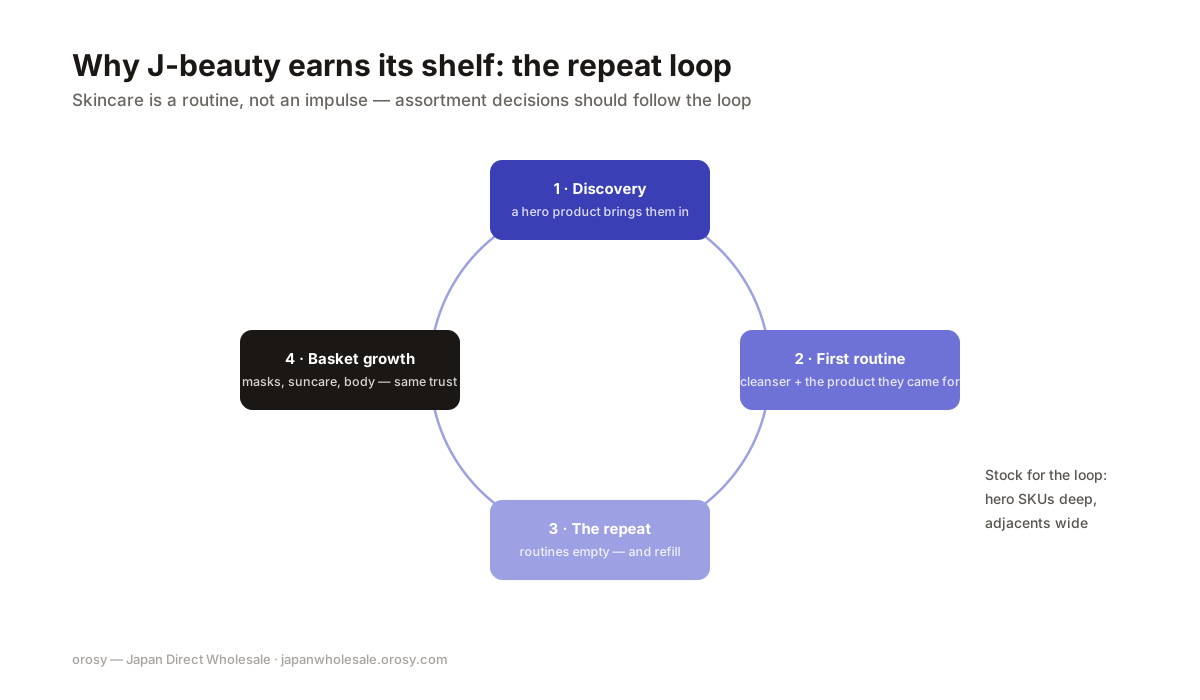
Before sourcing, it helps to plan around how the cosmetics category actually behaves at retail, independent of country of origin.
- It's a repeat-purchase category. Skincare and cosmetics are consumed and replenished, so the value of a customer is in reorder cadence, not a single sale. That rewards carrying staples with stable demand over chasing one-off novelties.
- Testers and sampling matter. Beauty is high-consideration and texture-driven — shoppers want to feel a sunscreen or a cleanser before committing. Sampling, testers, and discovery sets are part of the cost of doing business in the category, and you should budget for them in your buy.
- Average order value and basket-building. Routines lend themselves to multi-product baskets (cleanse, hydrate, protect), so assortment depth within a line can lift basket size in a way that single-item categories don't.
None of these are Japan-specific — they're how beauty works — but they change what a "good buy" looks like versus, say, stationery or homeware. Plan for replenishment, freshness, and sampling from the start.
The regulatory layer you can't skip
Cosmetics is one of the few consumer categories where there's a real federal compliance layer in the US, and it changed recently. Buyers should understand it at a high level and route the details to a specialist.
Under the Modernization of Cosmetics Regulation Act of 2022 (MoCRA) — which the FDA describes as a major expansion of its cosmetics authority, the largest since 1938 — the US now requires that cosmetic product facilities be registered with the FDA and that marketed cosmetic products be listed with the agency, with renewals and updates on a set cadence. There are some small-business exemptions, and certain product types (for example, products that contact the eye's mucous membrane) are treated differently. (FDA, Registration & Listing of Cosmetic Product Facilities and Products, Federal Register, MoCRA registration & listing guidance)
What this means for a buyer is simply that who is responsible for which obligation — facility registration, product listing, labeling, the designated "responsible person" — needs to be settled before product reaches your shelves, and it's a question of regulatory roles, not just logistics. This guide intentionally stops at the high level: MoCRA obligations depend on your specific products, business size, and supply structure, so consult your regulatory advisor to confirm how the rules apply to you. The takeaway is to factor the compliance layer into your category plan early rather than discover it at the border.
Sourcing routes: the category-specific angle
The mechanics of getting Japanese product into your assortment are the same here as for any category — US importers, trade shows, direct supplier contracts, B2B marketplaces, or a sourcing partner — and the guide walks through all five routes, with an honest comparison of selection versus operational load, in our companion guide.
→ How to source Japanese products wholesale in the US
What's specific to beauty is the overlay on top of those routes:
- The compliance layer follows the route. A US-based importer that already carries Japanese cosmetics has, in principle, dealt with the listing and registration questions for what they stock — which is part of why the importer route is the lowest-friction entry. Sourcing closer to the maker gives you more selection but pushes more of the compliance coordination onto your side. (Confirm specifics with your regulatory advisor in every case.)
- Freshness and shelf life. Cosmetics have meaningful shelf lives and, in some cases, period-after-opening considerations. Longer, less predictable lead times from direct international shipping interact with that — a factor that matters less for non-perishable goods.
- Formula and SKU matching. As the sunscreen example shows, the Japanese-market version of a product can differ from any US-market namesake. Buyers sourcing for the Japanese formula specifically need to confirm they're getting the SKU their customers actually want.
As with every category, the broad pattern holds: routes that are easiest to operate tend to give you a narrower, pre-curated selection, while reaching the full breadth of Japanese supply takes on more operational work — here, with compliance and freshness added to the usual language, MOQ, and customs friction.
Cost and customs for the beauty category
The landed-cost math for Japanese cosmetics follows the same structure as any Japanese import: product cost, import duties, and international freight, with the exact duty rate determined by each product's HTS classification rather than a single flat figure. We walk through duties, customs, and logistics in detail in our dedicated cost guide.
→ Importing Japanese products: customs, duties, and logistics
Two category-specific notes worth carrying into your landed-cost model:
- Compliance has a cost. Registration, listing, labeling review, and the designated responsible-person function are real line items for the category, whoever bears them. Make sure your model reflects who carries them in your chosen route.
- Duties exist in every route. When you buy from a domestic importer who has already landed the product, the duty is already inside the price you pay; when you source closer to Japan, you carry it directly. No route makes duties disappear — the difference is who does the clearing work and how visible the cost is to you.
orosy — Japan Direct Wholesale
orosy connects US buyers to a wide breadth of Japanese supply — 4,000+ Japanese brands and suppliers, over 1 million products, and 20,000+ buyers on the marketplace — so your assortment isn't bounded by the short list one importer happened to stock. The name comes from the Japanese word orosu (卸す), "to wholesale," and orosy was founded in 2018.
For a beauty buyer, the relevant part is the operational model: orosy handles sourcing, customs, and international logistics, so instead of assembling importers, agents, and freight forwarders yourself, the cross-border work runs through one workflow. Because orosy buys at Japanese wholesale prices through direct supplier relationships, your pricing is built on that purchasing power, with fewer intermediaries between you and the maker than a typical import chain. The costs that don't disappear — duties and freight — pass through and are billed at cost, so your landed-cost model stays predictable. (Beauty's regulatory obligations under MoCRA are a separate, category-specific matter to confirm with your regulatory advisor.)
If you'd rather choose from Japan's full shelf than from someone else's catalog, you can join the waitlist here:
FAQ
Is there real US wholesale demand for Japanese skincare and cosmetics?
Yes. The J-beauty category was estimated at roughly USD 35–37 billion globally in 2025 and is growing at a mid-single-digit rate, with the US as one of its larger markets and skincare as the dominant segment. Demand is also specific in places — Japanese sunscreens, for example, have a durable US following because the Japanese formulas differ from their US-market namesakes.
How is J-beauty different from K-beauty for my assortment?
They differ in approach, not quality. J-beauty leans toward minimal routines and hero products refined incrementally over many years, while K-beauty leans toward novelty, layering, and faster product rotation. For assortment planning, J-beauty's slower formula cadence means hero SKUs tend to stay stable, which can make reordering and shelf positioning more predictable. Many US retailers carry both.
What US regulations apply to importing Japanese cosmetics?
Under the Modernization of Cosmetics Regulation Act (MoCRA), the US now requires cosmetic facility registration and product listing with the FDA, with renewals and updates on a set cadence, plus a designated responsible person — with some small-business exemptions and product-type nuances. This is a high-level summary only; how the rules apply depends on your specific products and business, so consult your regulatory advisor.
What sourcing route should a beauty buyer use?
The same five routes apply as for any Japanese product — US importers, trade shows, direct contracts, B2B marketplaces, or a sourcing partner — and our companion sourcing guide compares them. For beauty specifically, factor in the regulatory layer (which tends to be more pre-handled when you buy from a domestic importer), product shelf life, and confirming you're getting the Japanese-market formula your customers want rather than a different US-market version.
Sources
- J-Beauty Products Market size and skincare share, Market.us: https://market.us/report/j-beauty-products-market/
- US J-Beauty Products Market outlook, Grand View Research: https://www.grandviewresearch.com/horizon/outlook/j-beauty-products/united-states
- Kao's Bioré UV sunscreen and US demand, cosmeticsdesign-asia: https://www.cosmeticsdesign-asia.com/Article/2025/01/08/kaos-biore-launching-first-uv-absorber-free-sunscreen-to-meet-increasing-consumer-demand/
- Bioré Aqua Rich SPF — Japanese vs US version, The Daily Beast: https://www.thedailybeast.com/biore-aqua-rich-spf-vs-uv-aqua-rich-watery-essence/
- K-Beauty vs J-Beauty explained, NewBeauty: https://www.newbeauty.com/view/k-beauty-vs-j-beauty-explained
- J-Beauty vs K-Beauty, Dermstore: https://www.dermstore.com/blog/j-beauty-vs-k-beauty/
- Registration & Listing of Cosmetic Product Facilities and Products (MoCRA), FDA: https://www.fda.gov/cosmetics/registration-listing-cosmetic-product-facilities-and-products
- Registration and Listing of Cosmetic Product Facilities and Products — Guidance, Federal Register: https://www.federalregister.gov/documents/2024/12/12/2024-29237/registration-and-listing-of-cosmetic-product-facilities-and-products-guidance-for-industry
orosy — Japan Direct Wholesale
Choose from Japan’s full shelf — not someone else’s catalog.
orosy connects US buyers to 5,000+ Japanese brands and 200,000+ products, and handles sourcing, customs, and international logistics — while duties and freight pass through, billed at cost.
Join the waitlistWritten by
Kanji NoguchiFounder, orosy
Founder of orosy. Building direct wholesale access between Japanese brands and US buyers.
Keep reading
Category Guides
Japanese Crafts & Goods Wholesale: A Sourcing Guide for US Boutiques and Gift Retailers
June 5, 2026 · 11 min read
Category Guides
Japanese Food & Snacks Wholesale: A Sourcing Guide for US Retailers
June 5, 2026 · 10 min read
Category Guides
Japanese Home & Kitchen Wholesale: A Sourcing Guide for US Retailers
June 5, 2026 · 11 min read