Category Guides
Japanese Crafts & Goods Wholesale: A Sourcing Guide for US Boutiques and Gift Retailers
A category-specific sourcing guide for US boutique, gift, and museum-shop buyers who want to add Japanese crafts and lifestyle goods wholesale — why this category protects margin, how its small-workshop-and-regional-wholesaler supply structure works, how to build small test buys, and the routes that fit crafts in particular.

On this page
- Why crafts and goods are a margin-protecting category for boutiques
- How this category's supply is actually built
- The maker's story is a selling tool, not decoration
- How to structure small, staged test buys
- The routes that fit crafts specifically
- A note on the costs that come with the category
- orosy — Japan Direct Wholesale
- FAQ
Key takeaways
- Japanese crafts and lifestyle goods are a margin-protecting category for US boutiques because they are hard for mass marketplaces to commoditize.
- The supply runs through small workshops feeding regional wholesalers (ton'ya) — catalogs perfected for the Japanese domestic market, which is exactly why they're hard to find from overseas.
- Each product's maker story is a real selling tool on the shelf and the sell sheet, not decoration — and it travels best when you can name the region and technique.
- Minimum order quantities are real, but crafts are well-suited to staged test buys: start narrow, prove sell-through, then widen.
- Trade shows (the Tokyo International Gift Show in particular) and curated marketplaces are practical entry routes that fit this category especially well.
Why crafts and goods are a margin-protecting category for boutiques
If you buy for a boutique, a gift shop, or a museum store, your hardest competitor is rarely the shop down the street — it's the search bar. The moment a product is identical to something a customer can find on a large marketplace, the conversation becomes price, and price is a race a small retailer is structured to lose.
This is the structural reason distinctive, hard-to-find product matters so much for independent retail. Goods that can't be cleanly matched to a generic marketplace listing are harder to commoditize, and that protects the one thing a small shop depends on: margin. Retailers who lean into unique assortments rather than commodity SKUs tend to defend healthier margins; private-label and differentiated goods, for example, are commonly cited as carrying meaningfully higher margins than national-brand equivalents — around 25% higher in industry analysis — precisely because they sidestep direct like-for-like price comparison. (Pattern — Amazon private label analysis) The same logic applies to imported crafts: a Japanese ceramic glaze, an Arita porcelain pattern, or a regional textile is not a SKU a shopper can paste into a search box and find ten near-identical listings of.
Japanese crafts and lifestyle goods sit squarely in that protected space. They read as design-forward and genuinely original on a US shelf, they photograph well, and they give a buyer a story to tell — all of which support a price that holds. For a gift or museum-shop buyer whose whole proposition is "things you won't see everywhere," this category does the differentiation work for you.
How this category's supply is actually built
To source crafts well, it helps to understand how the supply is organized — because the structure explains both the quality and the difficulty.
Japan's craft and lifestyle-goods supply runs through a deep layer of small and mid-size workshops, many concentrated in regional production centers that have specialized in one material or technique for generations. The country formally recognizes 243 nationally designated traditional crafts, each tied to a specific region and a body of producers — designation requires that the craft be made in a defined area by a producer base that is "not few in number." (METI — Act on the Promotion of Traditional Craft Industries, Traditional Crafts of Japan, Tohoku METI) That regional concentration — porcelain in one area, lacquerware in another, glass or textiles or paper in others — is why the quality runs so deep and so specialized.
Sitting between those workshops and the market is a long-standing wholesale layer: regional ton'ya (wholesalers) who aggregate output from many small makers, hold the relationships, and have refined these catalogs over decades. This is a structure worth respecting rather than working around. The workshops and the ton'ya spent generations perfecting product for the Japanese domestic market and selling through long-standing domestic relationships — the routes were simply built for Japan, not for an overseas buyer. That's the honest reason so little of this catalog is visible in English or available through a US-style ordering flow: not a gap in quality or ambition, but a supply chain whose front door faces inward. The same dynamic shapes every category of Japanese product; we covered the broader version of it in our complete guide to sourcing Japanese products wholesale in the US.
The takeaway for a buyer is encouraging, not discouraging: the difficulty you feel finding this product is the same difficulty that keeps it off everyone else's shelves. The supply is real, deep, and well-organized — it was just organized for a different market than yours.
The maker's story is a selling tool, not decoration
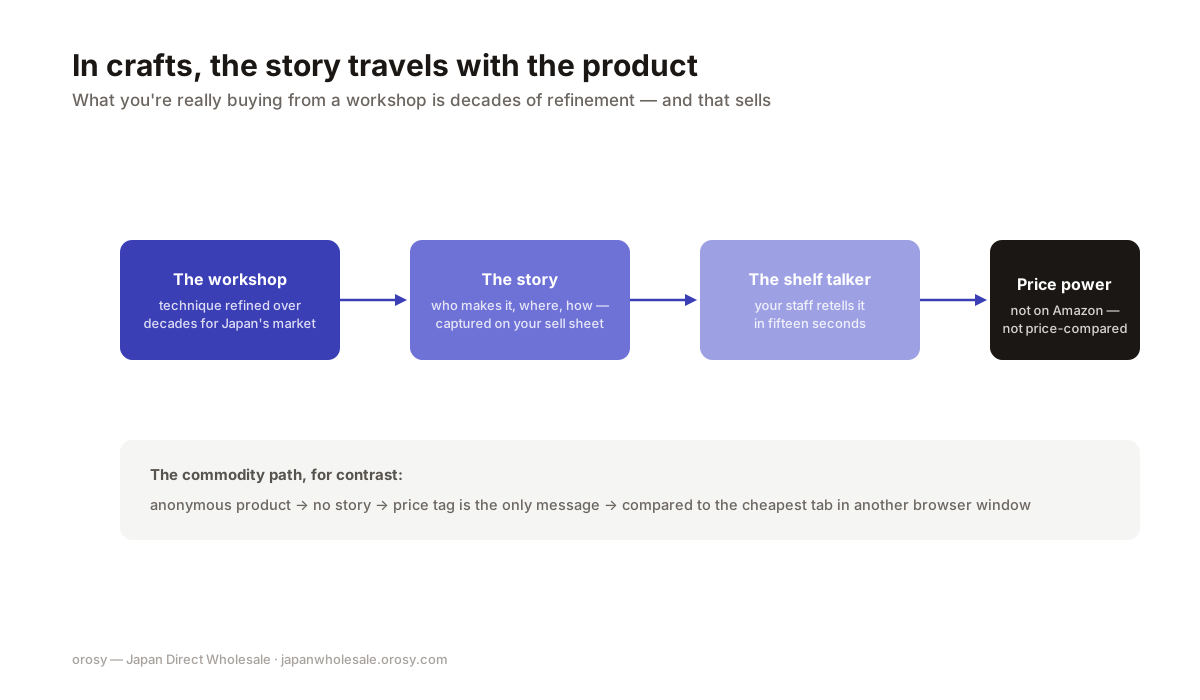
In most categories, "the story" is marketing garnish. In crafts, it's part of the product — and it directly affects what a customer will pay.
There's solid evidence that narrative changes buying behavior: shoppers exposed to a product's story describe the item more positively and report a higher willingness to pay, because the object feels more meaningful when it carries provenance. (RetailNext — why brand story matters for retailers, Emerald — storytelling in online shops and willingness to pay) For a gift or museum-shop buyer, that's not abstract — it's the difference between a shelf of nice objects and a shelf of objects a customer wants to give and explain.
What makes Japanese crafts unusually strong here is that the story is specific and true: a named region, a defined technique, a workshop that has made this one thing for a long time. You don't have to manufacture a narrative — you have to capture and carry the one that already exists. The practical move is to collect, at the point of buying, the few facts that make a sell sheet and a shelf-talker write themselves: where the piece is made, what the technique is, and what the workshop is known for. Stated plainly and accurately — as a fact of provenance, not as exotic decoration — that detail is what converts a browser into a buyer.
If you're a distributor placing these goods into other retailers rather than selling them yourself, that maker story becomes the core of your sell sheet to your accounts. We walk through how to package provenance into a sales narrative for downstream buyers in our playbook on adding a Japan section as a wholesale distributor.
How to structure small, staged test buys
The most common worry buyers raise about sourcing from Japan is minimum order quantities — and it's a fair one. MOQs are real, and they're set for the Japanese domestic market, which can mean they're sized larger than a US buyer wants for a first test of a single design.
But crafts are actually one of the better categories for staging your way in, for two reasons. First, the category rewards a narrow-and-deep buy: a boutique doesn't need fifty patterns of a ceramic, it needs a tight, coherent edit that fits its shelf. Second, sell-through in this category is legible — a distinctive object either moves at the price you set or it doesn't, and you learn that fast. That makes a staged approach natural:
A staged approach
- Start with a tight first edit: a handful of designs that fit your shelf and your customer, sized to clear the supplier's minimum without overbuying.
- Read sell-through honestly on a defined window, then reorder and widen the winners rather than spreading thin across everything at once.
- Use routes where minimums are pooled at the source (a marketplace or a sourcing partner that buys at scale) when a maker's own MOQ is larger than your test warrants.
What to plan for
- MOQs are set for the domestic market and won't bend to a foreign first-time order — plan the first buy around what the minimum actually is, not what you wish it were.
- Lead times on goods shipped from Japan are longer than domestic restocks, so build a reorder buffer in before a winner sells out.
- Landed cost includes duties and freight; put those in your model from the first buy so a strong sell-through isn't undercut by a surprise on the second order.
The principle is the same one good buyers use everywhere: spend your risk on learning, not on inventory. Crafts let you do that cleanly because the product is distinctive enough that the test gives you a clear signal.
The routes that fit crafts specifically
The five general routes for sourcing Japanese product — US importers, trade shows, direct contracts, B2B marketplaces, and buying agents — all apply here, and we compare them in depth in the complete sourcing guide. But for the crafts-and-goods category in particular, two of those routes carry more weight than the others.
Trade shows are unusually strong for this category. The Tokyo International Gift Show (TIGS) is Japan's largest gift and lifestyle fair, and its structure is tailored to exactly this product. Its LIFE×DESIGN segment is built around interior, tableware, textiles, and design crafts, and the show runs regional and prefecture-based zones — areas that group makers by production center and surface the smaller workshops a buyer would struggle to find any other way. (Tokyo International Gift Show — official, TIGS exhibiting categories) Walking those regional zones is one of the few ways to see breadth across many small craft makers in one place, meet them face to face, and understand the technique behind a piece before you buy it. The trade-off is the familiar one: after the handshake, you still own the export, language, and logistics work yourself.
Curated B2B marketplaces are the low-friction entry point. For buyers who want a modern ordering flow without managing individual workshop relationships, a marketplace gives you discovery, net terms, and a single checkout — at the cost of a curation layer that bounds your selection to onboarded brands. For Japanese supply specifically, that roster skews toward the export-ready few, which is worth knowing before you assume a marketplace shows you the full breadth of Japanese craft.
The other three routes still have their place — a US importer for immediate domestic-terms restocking, a direct contract for high-volume buyers with the resources to manage cross-border procurement, a buying agent when you want reach without in-house import capacity — but for a boutique or gift buyer building a distinctive craft assortment, trade shows and curated marketplaces are the practical first moves.
A note on the costs that come with the category
Two costs are real in every craft import and belong in your landed-cost model from the first order: import duties and international logistics.
Under the 2025 US–Japan framework agreement, most Japanese consumer goods are tariffed at roughly 15%, with the exact figure depending on the product's HTS classification rather than applying as one flat number across categories. (Congressional Research Service) Crafts span several classifications — ceramics, glass, textiles, and worked wood each fall under different lines — so the right move is to classify your specific products rather than assume a single rate. When you buy from a US-based importer or in-region marketplace stock, those costs are already inside the price you pay; when you buy direct, you carry them yourself. Either way the duty exists — the only question is who does the work of clearing it and whether it's visible to you. We break down the full duties-and-logistics picture in our guide to importing Japanese products: customs, duties, and logistics.
orosy — Japan Direct Wholesale
orosy was built around the exact friction this category creates: the best Japanese craft and lifestyle goods live behind a domestic-facing supply chain, and reaching across it has traditionally meant choosing between a narrow importer's catalog and doing all the cross-border work yourself.
The name comes from the Japanese word orosu (卸す), meaning "to wholesale." On orosy, your selection isn't bounded by what one importer chose to stock — the platform connects US buyers to a wide breadth of Japanese supply, with 4,000+ Japanese brands and suppliers, over 1 million products, and 20,000+ buyers on the marketplace. Founded in 2018, orosy's premise is that you should be able to reach across nearly the full range of what Japan makes — including the regional crafts and goods that rarely surface overseas — while orosy handles the sourcing, customs, and international logistics on your behalf.
Because orosy buys at Japanese wholesale prices through direct, long-standing supplier relationships, your pricing is built on that purchasing power, with fewer intermediaries between you and the maker than a typical import chain. The costs that don't disappear — duties and freight — are not hidden; they pass through and are billed at cost, so your landed-cost model stays honest and predictable. What changes is the operational burden: instead of assembling importers, agents, and freight forwarders, your sourcing and cross-border movement run through one workflow.
If you'd rather choose from Japan's full shelf of crafts than from someone else's catalog, you can join the waitlist here:
FAQ
What counts as 'Japanese crafts and goods' for a US boutique buyer?
In practice it's a broad lifestyle category: ceramics and porcelain, glassware, textiles, lacquer and woodwork, washi paper and stationery, kitchen and tabletop tools, and design objects. Many trace to a specific regional production center and technique — Japan recognizes 243 nationally designated traditional crafts, each tied to a defined region — which is what gives the category its distinctiveness and its built-in story for the shelf.
Why are Japanese crafts hard to source from the US, and is that a quality problem?
It's not a quality problem — it's a routing one. The makers and regional wholesalers (ton'ya) spent decades perfecting their catalogs for the Japanese domestic market and selling through long-standing domestic relationships, so the supply chain faces inward and little of it appears in English or in a US-style ordering flow. The difficulty you feel finding the product is the same difficulty that keeps it off your competitors' shelves.
How do I handle minimum order quantities when I just want to test a few designs?
MOQs are real and set for the domestic market, so plan your first buy around the actual minimum rather than an ideal one. Crafts suit a staged approach well: make a tight first edit that fits your shelf, read sell-through on a defined window, then reorder and widen the winners. When a maker's own minimum is larger than your test warrants, a marketplace or sourcing partner that buys at scale can pool it across buyers.
Which sourcing route is best for crafts specifically?
For this category, trade shows and curated B2B marketplaces tend to fit best. The Tokyo International Gift Show runs design-craft segments and regional pavilions that surface small workshops you'd struggle to find otherwise, while a curated marketplace gives you a low-friction ordering flow at the cost of a narrower, onboarded selection. US importers, direct contracts, and buying agents still have their place depending on your volume and in-house capacity.
Sources
- METI — New Designation under the Act on the Promotion of Traditional Craft Industries: https://www.meti.go.jp/english/press/2025/1027_003.html
- Traditional Crafts of Japan, Tohoku METI (designation overview): https://www.tohoku.meti.go.jp/s_kokusai/craft_en.html
- Tokyo International Gift Show — official site: https://www.giftshow.co.jp/english/tigs/
- Tokyo International Gift Show — exhibiting categories: https://www.giftshow.co.jp/english/tigs/category.htm
- RetailNext — why a brand story is critical for retailers: https://retailnext.net/blog/why-a-brand-story-is-so-critical-for-retailers/
- Emerald / Internet Research — storytelling in online shops and willingness to pay: https://www.emerald.com/intr/article/32/7/228/187556/Storytelling-in-online-shops-the-impacts-on
- Pattern — Amazon private label and differentiated-goods margin analysis: https://www.pattern.com/blog/amazons-private-label-brands/
- US Tariffs and the 2025 US–Japan Framework Agreement, Congressional Research Service: https://www.congress.gov/crs-product/IN12608
orosy — Japan Direct Wholesale
Choose from Japan’s full shelf — not someone else’s catalog.
orosy connects US buyers to 5,000+ Japanese brands and 200,000+ products, and handles sourcing, customs, and international logistics — while duties and freight pass through, billed at cost.
Join the waitlistWritten by
Kanji NoguchiFounder, orosy
Founder of orosy. Building direct wholesale access between Japanese brands and US buyers.
Keep reading
Category Guides
J-Beauty Wholesale: Sourcing Japanese Skincare & Cosmetics for US Retail
June 5, 2026 · 9 min read
Category Guides
Japanese Food & Snacks Wholesale: A Sourcing Guide for US Retailers
June 5, 2026 · 10 min read
Category Guides
Japanese Home & Kitchen Wholesale: A Sourcing Guide for US Retailers
June 5, 2026 · 11 min read