Category Guides
Japanese Food & Snacks Wholesale: A Sourcing Guide for US Retailers
A practical sourcing guide for US grocery, specialty-food, and Asian-grocery buyers on stocking Japanese food and snacks wholesale — how the category is structured by shelf life and temperature, the food-specific regulatory layer (FDA prior notice, facility registration, labeling), why US-based importers dominate this category, and how duties and logistics factor into landed cost.

On this page
Key takeaways
- Japanese food and snacks are moving from specialty-aisle novelty toward mainstream US retail, and demand for the category is broadening beyond Asian-grocery channels.
- Food is structured differently from other Japanese categories: shelf life, temperature class, and turnover decide what you can realistically carry, not just what you like.
- A food-specific regulatory layer applies — FDA prior notice, facility registration, and US labeling rules exist on top of normal import duties.
- Because of that compliance load, US-based importers with already-cleared inventory are unusually strong in food — at the cost of a narrower assortment than Japan actually offers.
- Duties and freight apply to food imports the same as any other category; the question is who carries the clearing work and whether the costs stay visible.
The demand is real, and it's no longer niche
Japanese snacks have crossed over. Products that once lived only in Asian-grocery aisles — matcha-flavored confections, premium rice crackers, ramen, Japanese-style candies and chocolates — now show up in mainstream US grocery, convenience, and specialty-food shelves, helped along by social-media discovery and a generation of US shoppers who treat Japanese flavors as everyday rather than exotic. Trade press covering the US food industry has tracked Japanese snacks moving steadily into broader retail distribution rather than staying a specialty curiosity. (Food Business News)
The export data backs up the pull. Japan's agricultural, forestry, fishery, and food exports reached roughly ¥1.70 trillion in 2025, and exports to the United States specifically came to about ¥276.2 billion — up 13.7% year over year, putting the US among Japan's rapidly growing food-export destinations. (Nippon.com, Japan's Ministry of Agriculture, Forestry and Fisheries (MAFF))
For a US buyer, that's the easy part. The demand signal is clear, and the category sells. The harder part — as with every Japanese category — is building a reliable, repeatable wholesale supply into your assortment. And food adds two layers that homeware, stationery, or beauty don't: it spoils, and it's regulated.
How the food category is actually structured
Before you think about routes and suppliers, it helps to understand how food forces decisions that other categories don't. Three structural realities shape what you can carry.
Shelf life dictates your buying cadence. A ceramic bowl can sit in a warehouse for a year. A bag of rice crackers cannot. Japanese snacks and confections carry a defined best-by date, and the clock starts in Japan, not when the product lands in the US. By the time a product is manufactured, exported, cleared, and distributed, a meaningful slice of its shelf life is already gone — which makes remaining shelf life a buying criterion in its own right. A product with strong demand but little dating left is a markdown waiting to happen.
Temperature class determines feasibility. Food splits into shelf-stable (ambient), chilled, and frozen, and each step up in temperature control adds cost and complexity to cross-border movement. The bulk of Japanese snacks and packaged foods that travel well into US retail are shelf-stable for exactly this reason — ambient goods consolidate easily, tolerate ocean transit, and don't require a cold chain that general importers aren't set up to run. Chilled and frozen Japanese food exists in the US market, but it's a specialist's game.
Turnover has to clear the dating math. In non-perishable categories you can afford slow movers. In food you generally can't: a slow-selling SKU doesn't just tie up cash, it ages toward expiry on your shelf. So food buyers favor proven, high-rotation items and treat experimental SKUs as small, deliberate bets.
None of this is unique to Japanese food — it's general perishable-category discipline. But it explains why the sourcing routes that work for Japanese homeware don't map cleanly onto Japanese snacks, and why the compliance layer below matters so much.
The regulatory layer that food adds
Here is where Japanese food diverges sharply from every other Japanese category. Imported food into the US sits under federal food-safety oversight that simply doesn't apply to a stapler or a teapot. At a high level, three things exist that a food buyer should know about:
- Prior notice. The US Food and Drug Administration (FDA) requires advance notice of imported food shipments before they arrive, so the agency can review incoming food. This is a distinct step from ordinary customs entry.
- Facility registration. Food facilities that manufacture, process, pack, or hold food for US consumption generally need to be registered with the FDA — and that obligation reaches foreign facilities, including Japanese ones, that send food to the US.
- Labeling. Imported food must meet US labeling requirements, which can differ from what a Japanese product carries for its domestic market — covering things like English-language information, ingredient and allergen disclosure, and nutrition presentation.
This guide is deliberately not walking you through how to do any of these. Food-import compliance is detailed, it changes, and getting it wrong has real consequences — so the right move is to work with your importer of record, a licensed customs broker, or a regulatory advisor rather than treat a blog post as a procedure. It appears here because this layer is the main reason the food category behaves differently from the rest of Japanese sourcing: someone has to carry this work, and who carries it is what separates the easy routes from the hard ones.
Before you commit to a route, consult your regulatory advisor or a licensed customs broker about how prior notice, facility registration, and labeling apply to the specific products and suppliers you're considering. Nothing here is legal or regulatory advice.
Why US-based importers are unusually strong in food
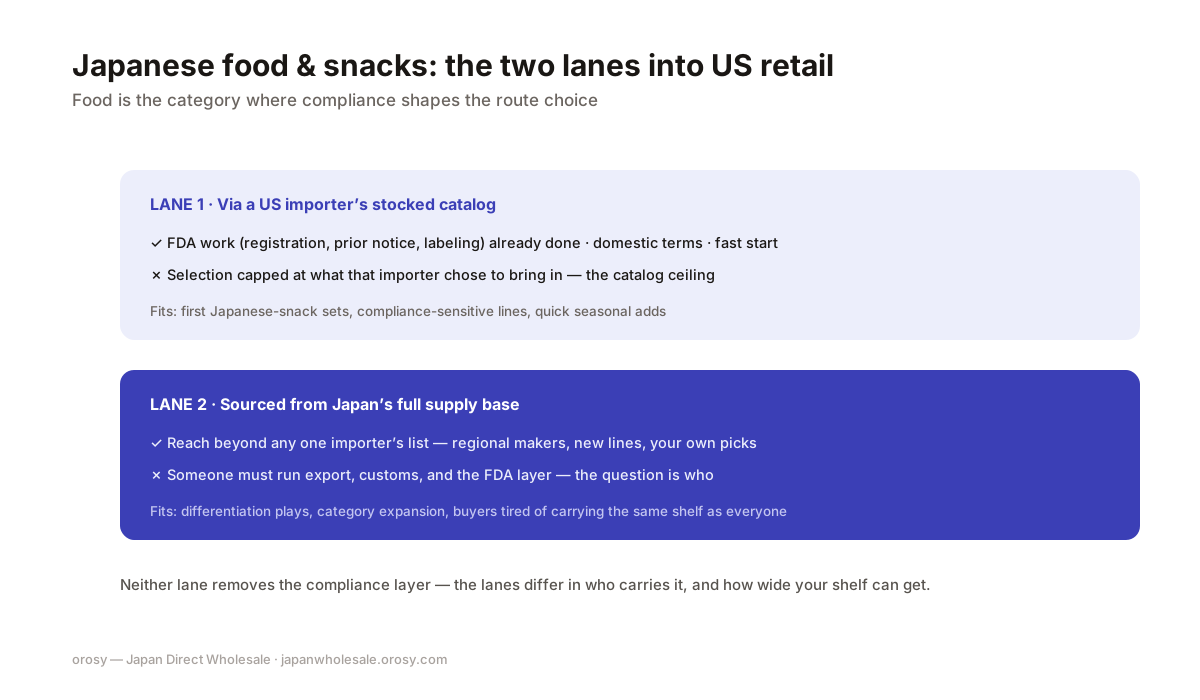
In our complete guide to sourcing Japanese products wholesale, we compared five routes — US-based importers, trade shows, direct manufacturer contracts, B2B marketplaces, and buying agents — and the general pattern was that the easiest routes give you the narrowest selection. In food, that pattern is even more pronounced, and it tilts hard toward one route in particular.
Route A — buying from a US-based Japanese-food importer — is disproportionately strong for this category, for a specific reason: the importer has already carried the regulatory layer. When you buy already-cleared inventory from a domestic food importer, the prior notice was filed, the facility registration was in place, the labeling was sorted, and the product cleared FDA and customs before it reached the importer's warehouse. You buy it on domestic terms, the way you'd buy from any US food distributor. For a buyer who wants to add Japanese snacks to the shelf next month — not next year — that compliance shortcut is worth a great deal, which is why so much Japanese food reaches US retail through domestic importers and distributors rather than directly from Japanese makers.
But the same trade-off from the general guide applies, and arguably bites harder here. The importer's catalog is the ceiling on your selection. A US-based Japanese-food importer carries the SKUs they chose to register, clear, and stock — typically the proven, high-rotation, shelf-stable items that move predictably. That's a sensible commercial bet, but it means the long tail of Japanese food — regional makers, smaller confectioners, seasonal items, the distinctive products that would differentiate your shelf — rarely makes it into that catalog, because the per-SKU compliance and clearing cost is too high to justify for a niche item. You inherit a pre-filtered shortlist, optimized for the importer's economics, not for your assortment.
The direct routes (contracting Japanese food makers, or meeting them at trade shows) would in principle open up that long tail — but in food they reintroduce the full compliance burden. Now you are the importer of record responsible for prior notice, ensuring the foreign facility is registered, getting US-compliant labeling sorted, and clearing customs — all on perishable goods with a running shelf-life clock. That's a heavy operation to stand up for a first test order, which is why many food buyers default to the importer route and accept the narrower selection.
The costs that apply to food, too
Whichever route you choose, two costs are real in food just as in every other Japanese category: import duties and international logistics.
Under the 2025 US–Japan framework agreement, the duty picture varies by product, and food has its own classification nuances — agricultural and food products sit in their own corners of the tariff schedule, and the exact rate comes down to the product's HTS classification rather than one flat number. The structure (why the rate is ad valorem, and why the cost exists in every route — already inside the price when you buy from a domestic importer) is the same logic that applies to any Japanese import. We covered that mechanism in detail in our guide to importing Japanese products: customs, duties, and logistics, worth reading alongside this one before you build a landed-cost model. For the duty treatment of a given food product, confirm the HTS classification with a licensed customs broker — food classifications can be more granular than general merchandise.
On logistics, food adds the temperature and shelf-life constraints described earlier: shelf-stable goods consolidate and move on ordinary ocean or air freight, while anything chilled or frozen needs a cold chain that general operators won't run. In Route A (domestic importer) and in-region marketplace stock, these costs are already inside the price you pay. In the direct routes, you carry and time them yourself — and in food, freight timing and shelf life are linked in a way they never are for durable goods.
orosy — Japan Direct Wholesale
orosy was built around the trade-off this guide keeps returning to: the belief that buyers shouldn't have to choose between broad selection and a manageable operation — and in food that choice is especially stark, because the compliance layer pushes everyone toward the same narrow importer shortlist.
The name comes from the Japanese word orosu (卸す), meaning "to wholesale." On orosy, the assortment isn't bounded by what one food importer chose to register and stock — the platform connects US buyers to a wide breadth of Japanese supply, with 4,000+ Japanese brands and suppliers, over 1 million products, and 20,000+ buyers on the marketplace. Founded in 2018, orosy's premise is that you should be able to reach across nearly the full range of what Japan makes, while orosy handles the sourcing, customs, and international logistics on your behalf. Duties and freight don't disappear — they pass through and are billed at cost, so your landed-cost model stays predictable. And because orosy buys at Japanese wholesale prices through direct supplier relationships, your pricing is built on that purchasing power, with fewer intermediaries than a typical import chain. For food, that means a path to the regional and distinctive products that rarely survive a domestic importer's per-SKU compliance math — without you standing up the import-and-compliance operation yourself.
If you'd rather choose from Japan's full shelf than from someone else's catalog, you can join the waitlist here:
FAQ
What is the easiest way for a US retailer to start carrying Japanese snacks wholesale?
The lowest-friction entry is buying already-cleared inventory from a US-based importer that specializes in Japanese food, or ordering through an in-region B2B marketplace. Because the importer has already handled FDA prior notice, facility registration, labeling, and customs, you buy on domestic terms with no compliance work of your own. The trade-off is selection: you're limited to the proven, shelf-stable SKUs that importer chose to stock, not the full breadth of Japanese food.
Do I need to handle FDA requirements myself when importing Japanese food?
It depends on your route. If you buy already-cleared inventory from a US-based importer, that importer has carried the FDA-related work (such as prior notice and facility registration) and US labeling before the product reached you. If you import directly from a Japanese supplier, you generally take on those obligations as the importer of record. Either way, food-import compliance is detailed and consequential, so consult your regulatory advisor or a licensed customs broker about how it applies to your specific products and suppliers. This is not legal or regulatory advice.
Why is the selection of Japanese food narrower through importers than what I see in Japan?
Food carries a per-SKU compliance and clearing cost — prior notice, facility registration, labeling, and customs — on top of a shelf-life clock that starts in Japan. That cost is easy to justify for proven, high-rotation, shelf-stable items, but hard to justify for regional makers, smaller confectioners, and seasonal products. So domestic importers rationally stock the safe movers, and the distinctive long tail of Japanese food mostly never enters their catalogs. The selection you see is filtered by the importer's economics, not by what Japan makes.
Do import duties apply to Japanese food and snacks?
Yes — duties apply to food imports the same as any other category, and the cost exists in every route (when you buy from a domestic importer, it's already inside the price). Under the 2025 US–Japan framework, the exact rate comes down to the product's HTS classification, and food classifications can be more granular than general merchandise. Confirm the specific duty treatment of a given product with a licensed customs broker, and read our customs and duties guide for how the mechanism works.
Sources
- Food Business News (US food industry trade coverage of Japanese snacks in retail): https://www.foodbusinessnews.net/
- Nippon.com (reporting on Japan's 2025 agricultural and food exports): https://www.nippon.com/en/
- Japan's Ministry of Agriculture, Forestry and Fisheries (MAFF) — agricultural and food export statistics: https://www.maff.go.jp/e/
- US Food and Drug Administration (FDA) — imported food oversight (prior notice, facility registration, labeling): https://www.fda.gov/food/importing-food-products-united-states
- US Tariffs and the 2025 US–Japan Framework Agreement, Congressional Research Service: https://www.congress.gov/crs-product/IN12608
orosy — Japan Direct Wholesale
Choose from Japan’s full shelf — not someone else’s catalog.
orosy connects US buyers to 5,000+ Japanese brands and 200,000+ products, and handles sourcing, customs, and international logistics — while duties and freight pass through, billed at cost.
Join the waitlistWritten by
Kanji NoguchiFounder, orosy
Founder of orosy. Building direct wholesale access between Japanese brands and US buyers.
Keep reading
Category Guides
J-Beauty Wholesale: Sourcing Japanese Skincare & Cosmetics for US Retail
June 5, 2026 · 9 min read
Category Guides
Japanese Crafts & Goods Wholesale: A Sourcing Guide for US Boutiques and Gift Retailers
June 5, 2026 · 11 min read
Category Guides
Japanese Home & Kitchen Wholesale: A Sourcing Guide for US Retailers
June 5, 2026 · 11 min read