Category Guides
Japanese Stationery Wholesale: A Sourcing Guide for US Retailers
A practical sourcing guide for US stationery and gift buyers on wholesaling Japanese pens, notebooks, and paper goods — why the category sells, how its small minimums and fast turns shape buying, the routes to source it, and how to build an assortment that differentiates your shelf.


On this page
Key takeaways
- Japanese stationery is a high-margin, shelf-differentiating category: strong design reputation, frequent novelty, and impulse-friendly price points.
- The category's economics favor retailers — pens, notebooks, and paper goods often carry smaller minimums and turn faster than bulkier import categories.
- Sourcing routes range from US-based importers (easy, narrow) to direct Japanese suppliers (broad, operationally heavy); your category and volume decide the fit.
- Import duties and freight apply to every Japanese import — the question is who carries the clearing work and whether the cost is visible to you.
- A strong stationery assortment mixes proven everyday workhorses with a rotating novelty slot that keeps regulars coming back.
Why Japanese stationery sells in US stores
If you buy for a gift shop, a bookstore, a design-goods boutique, or a multi-store specialty chain, you have likely already watched Japanese pens and notebooks move off the shelf faster than you expected. The demand is real, and it isn't a fad cycle — it rests on a reputation built over more than a century.
The major Japanese writing-instrument makers are old, deep companies. Pentel traces its roots to 1897; Kokuyo was founded in 1905; Pilot was established in 1918. (JetPens — 100 Years of Japanese Stationery) Over those decades they refined a set of products that the global stationery community now treats as benchmarks: Pilot's gel and erasable lines, Pentel's markers and mechanical pencils, Zebra's gel rollerballs, and Midori's flat-opening MD notebooks built on its own house paper. (JetPens — Japanese Stationery) These are stated here as market facts — widely recognized brands that shape what US shoppers expect from "Japanese stationery" — not as products orosy represents or is affiliated with.
The export numbers reflect that pull. According to the Japan Writing Instruments Manufacturers Association (JWIMA), the export value of writing instruments reached around ¥120 billion in 2023, up nearly 15% from 2018 — growth attributed in part to the rise of ecommerce and cross-border trade. (FedEx Business Insights — Why The World Loves Japanese Stationery) The category sits inside a large and growing global market: the global stationery and supplies market was estimated at roughly USD 152 billion in 2025 and is projected to reach about USD 206 billion by 2031, a CAGR of around 5%. (Mordor Intelligence — Global Stationery & Supplies Market)
For a US buyer, the appeal is practical, not nostalgic. Japanese stationery gives a shelf three things at once: a design story customers already trust, products at impulse price points, and a steady stream of new releases that gives regulars a reason to come back. That combination is hard to assemble from generic domestic stationery lines.
How the category's structure shapes your buying
Stationery behaves differently from heavier Japanese import categories like kitchenware, ceramics, or packaged food, and those differences work in a retailer's favor.
Smaller minimums, easier to test. Pens, refills, sticky notes, and pocket notebooks are small, light, and inexpensive per unit. That tends to make first orders easier to size to a real test rather than a warehouse commitment, and it lowers the cost of being wrong about a single SKU. (Minimums are always set by the individual supplier and vary by maker and route — verify each before you commit.)
Faster turns. Stationery is consumable and giftable. Pens run out, notebooks fill up, and the category is a natural impulse and gift purchase near the register. Faster turns mean working capital comes back to you sooner than it does on slow-moving display goods.
Shelf differentiation per square foot. A pen wall or a notebook table takes little floor space but can become a destination. Because the category rewards variety and frequent novelty, a well-curated stationery section differentiates a store out of proportion to the space it occupies — a real advantage for independents competing against big-box assortments.
Novelty is a feature, not a problem. Japanese makers release new colors, seasonal editions, and collaborations on a regular cadence. For a category like furniture that would be churn; for stationery it's the engine. A rotating novelty slot is what turns a one-time buyer into a regular.
The takeaway: stationery is one of the friendlier Japanese categories to enter, because the unit economics let you start small. The harder part — as with every Japanese category — is reaching the suppliers in the first place.
Sourcing routes, with the stationery-specific notes
The five routes to source any Japanese product wholesale apply here too: buying from a US-based importer, opening accounts at a Japanese trade show, contracting suppliers directly, using a B2B marketplace, or working through a buying agent. We compare all five — cost, lead time, and operational load — in our complete guide to sourcing Japanese products wholesale in the US. Here are the notes that matter specifically for stationery.
US-based importers are the lowest-friction start, and stationery is well represented among them because the products are easy to warehouse and ship domestically. The trade-off is the same as in any category: your assortment is capped at whatever that importer chose to carry, so the distinctive releases that make the category exciting are often the ones you can't get.
Trade shows for stationery are their own world. Beyond the broad Tokyo International Gift Show, Japan runs a dedicated stationery fair — ISOT, the International Stationery & Office Products Fair at Tokyo Big Sight, described as Asia's largest stationery and office-products trade fair, with the 2026 summer edition scheduled for June 24–26. (ISOT / showsbee) Its visitor profile is explicitly importers, wholesalers, and retail buyers, which makes it a strong place to meet makers face to face — at the cost of travel, timing around the show calendar, and owning export and logistics yourself afterward.
Direct supplier contracts give the deepest access to original product and the best unit economics, but Japanese makers operate in Japanese, follow local business norms, and set minimums for the domestic market. Stationery's smaller unit sizes soften the minimum problem somewhat compared to bulkier categories, but the language, documentation, and customs-of-record burden remain real.
B2B marketplaces offer a familiar ordering flow and curated discovery, and several carry Japanese stationery brands. The structural catch is the same one explained in the main guide: the suppliers you see are the export-ready few who can run their own US shipping and customs, so the roster skews narrow relative to what Japan actually makes.
The pattern holds across the whole category: the easiest routes give you the least selection, and the broadest selection demands the most operational work.
The costs that apply on every route: duties and freight
Whichever route you pick, two costs are real on every Japanese import and belong in your landed-cost model from day one: import duties and international logistics.
Under the 2025 US–Japan framework, most Japanese consumer goods are tariffed at roughly 15%, with the exact figure depending on the product's HTS classification — so the rate varies by category rather than applying as one flat number. Critically, the duty exists in every route: when you buy from a domestic importer, it is already inside the price you pay; when you buy direct, you owe it yourself. The tariff structure, HTS classification, and freight options are covered planning in depth in our guide to importing Japanese products: customs, duties, and logistics — start there before you build your first landed-cost spreadsheet. The short version for stationery: because the products are small and light, freight per unit is usually modest, but duties still apply on value, and no route makes them disappear.
How to build a Japanese stationery assortment
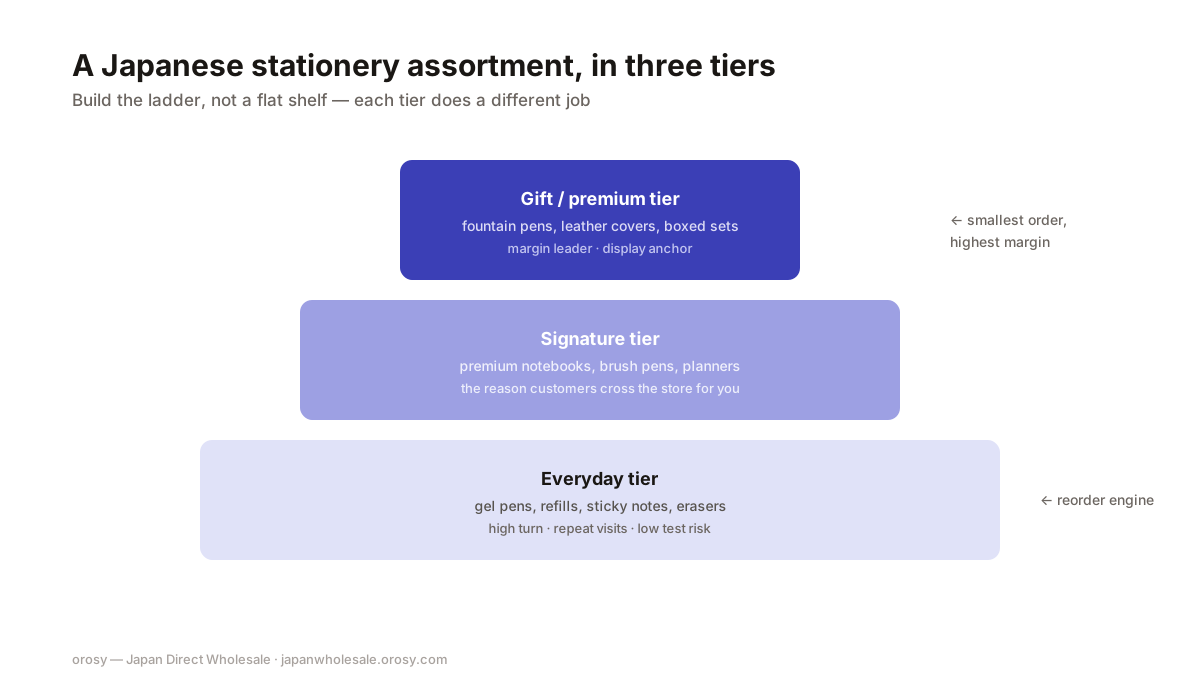
A stationery section works when it's deliberately layered rather than randomly stocked. A simple framework:
Anchor with proven workhorses. Every Japanese stationery section needs reliable everyday writers and notebooks at accessible price points — the gel pens, mechanical pencils, and pocket notebooks that customers buy, use up, and come back to replace. These are your turn drivers and your repeat-purchase base. They don't need to be exotic; they need to be dependable and reorderable.
Layer in a mid-tier of design-forward pieces. Above the everyday workhorses sits a tier of notebooks, planners, and pens chosen for their design and giftability — the items a customer picks up because they look considered. This is where the "Japanese design" reputation earns its margin, and where slightly higher price points sit comfortably.
Reserve a rotating novelty slot. Keep a defined portion of the section for new colors, seasonal editions, and limited releases. This is the part that gives regulars a reason to check back and that you can refresh without disrupting your anchor SKUs. Treat it as a planned, recurring buy, not an afterthought.
Spread across price tiers. A mix from impulse-priced pens up to gift-priced notebook sets lets the section serve both the quick add-on at the register and the deliberate gift purchase. Concentrating only at one tier leaves money on the table.
The constant tension is the same one that runs through the whole sourcing question: a well-layered assortment needs range — and range is exactly what the easy, narrow routes can't give you.
Where orosy fits
orosy was built around that tension — the belief that a buyer shouldn't have to choose between a broad, distinctive assortment and a manageable operation. The name comes from the Japanese word orosu (卸す), meaning "to wholesale."
Rather than capping your selection at one importer's catalog, orosy connects US buyers to a wide breadth of Japanese supply — with 4,000+ Japanese brands and suppliers, over 1 million products, and 20,000+ buyers on the marketplace, founded in 2018. The premise: you choose across a wide range of what Japan makes, while orosy handles the sourcing, customs, and international logistics on your behalf. orosy buys at Japanese wholesale prices through direct, long-standing supplier relationships, so your pricing is built on that purchasing power. The costs that don't disappear — duties and freight — pass through and are billed at cost, so your landed-cost model stays predictable rather than buried in a markup. For a category like stationery, where the difference between an ordinary shelf and a destination is range and novelty, breadth of access is the part that matters most.
FAQ
What is the minimum order to start wholesaling Japanese stationery?
There's no single answer — minimums are set by each supplier and vary by maker, product, and sourcing route. That said, stationery's small, low-cost units generally make it easier to size a first order to a genuine test than bulkier import categories do. Always confirm the minimum with the specific supplier or platform before committing, and start with anchor items you're confident will reorder.
Do I pay import duties on Japanese pens and notebooks?
Yes — duties apply to Japanese stationery like any other import, and they exist in every sourcing route. Under the 2025 US–Japan framework, most consumer goods land at roughly 15%, with the exact rate set by the product's HTS classification. If you buy from a US importer the duty is already inside your price; if you source direct, you owe it yourself. Our customs and duties guide covers how to plan for it.
Why is Japanese stationery a good category for a small retailer?
Three reasons: the products carry a strong, customer-recognized design reputation; the unit economics favor smaller test orders and faster turns than heavier categories; and the category rewards frequent novelty, which gives regulars a reason to return. A pen wall or notebook table differentiates a store out of proportion to the floor space it takes.
Where can I see Japanese stationery suppliers in person?
Japan runs dedicated stationery trade fairs alongside its broader gift shows. ISOT, the International Stationery & Office Products Fair at Tokyo Big Sight, is described as Asia's largest stationery and office-products trade fair and explicitly draws importers, wholesalers, and retail buyers; the 2026 summer edition is scheduled for June 24–26. The broader Tokyo International Gift Show also features stationery exhibitors. Both require travel and, after the handshake, handling export and logistics yourself.
Sources
- JetPens — 100 Years of Japanese Stationery (brand histories: Pentel 1897, Kokuyo 1905, Pilot 1918): https://www.jetpens.com/blog/100-Years-of-Japanese-Stationery/pt/1016
- JetPens — Japanese Stationery (category overview, major brands): https://www.jetpens.com/Japanese-Stationery/ct/5690
- FedEx Business Insights — Why The World Loves Japanese Stationery (JWIMA: ~¥120B writing-instrument exports in 2023, +~15% vs 2018): https://www.fedex.com/en-jp/business-insights/ecommerce/how-japanese-stationery-is-winning-over-the-world.html
- Mordor Intelligence — Global Stationery & Supplies Market (size and CAGR): https://www.mordorintelligence.com/industry-reports/global-stationery-and-supplies-market
- ISOT — International Stationery & Office Products Fair Tokyo 2026 (dates, venue, visitor profile): https://www.showsbee.com/fairs/ISOT-Japan.html
orosy — Japan Direct Wholesale
Choose from Japan’s full shelf — not someone else’s catalog.
orosy connects US buyers to 5,000+ Japanese brands and 200,000+ products, and handles sourcing, customs, and international logistics — while duties and freight pass through, billed at cost.
Join the waitlistWritten by
Kanji NoguchiFounder, orosy
Founder of orosy. Building direct wholesale access between Japanese brands and US buyers.
Keep reading
Category Guides
J-Beauty Wholesale: Sourcing Japanese Skincare & Cosmetics for US Retail
June 5, 2026 · 9 min read
Category Guides
Japanese Crafts & Goods Wholesale: A Sourcing Guide for US Boutiques and Gift Retailers
June 5, 2026 · 11 min read
Category Guides
Japanese Food & Snacks Wholesale: A Sourcing Guide for US Retailers
June 5, 2026 · 10 min read